Eye Tracking in HCI — Science Mapping (2020–2025)
Status: emerging
Last updated: 2026-06-13
Sources: Korkmaz 2026 Eye Tracking Hci Science Mapping.Pdf
Tags: [eye-tracking, HCI, bibliometric, science-mapping, content-analysis, XR, gaze-estimation, deep-learning, cognitive-load, multimodal-interaction, accessibility, privacy, review]
Summary
Korkmaz (2026) maps the field of eye-tracking research in human–computer interaction (HCI) for 2020–2025, combining 1033 publications drawn from Web of Science and Scopus. Bibliometric network analyses (keyword co-occurrence, co-citation, co-authorship, source mapping) in VOSviewer are paired with a qualitative content analysis of the 50 most-cited papers. Four principal research axes emerge: deep-learning-based gaze estimation; extended-reality (XR) interaction paradigms; cognitive load and human factors; and usability- and accessibility-oriented interface design. A time-overlay keyword map shows a thematic shift from survey- and method-oriented work in 2020–2021, through diversification of application domains in 2022–2023, to XR, advanced machine learning, and gaze-controlled devices in late 2023–2024. The review's overall position is that eye tracking in HCI is moving from a measurement technique toward a core enabling technology for interaction design, cognitive assessment, accessibility, and privacy-aware systems.
Body
Context
This article rests on a single source: Korkmaz's (2026) open-access science-mapping and content-analysis study in the Journal of Eye Movement Research, which examines how eye tracking is positioned within the broader HCI field rather than within one subdomain (PDF p. 2, orig. p. 2). Its method is bibliometric: WoS and Scopus records are merged and deduplicated in VOSviewer, network maps are generated, and the 50 most-cited papers are read qualitatively. Within this knowledge base the article is a field-level map rather than a topic deep-dive: it situates the KB's existing single-topic articles against the structure of the wider literature, connecting to Gaze Interaction In Extended Reality and Eye Tracking In Virtual Reality (the XR axis), Appearance Based Gaze Estimation (the deep-learning gaze-estimation axis), Pupil Dilation Cognitive Load (the cognitive-load axis), and Gaze Based Hci And Usability (the usability/accessibility axis). It is the bibliometric counterpart to the narrative surveys already compiled here.
Key Points
Corpus and methodology. A Boolean query combining eye-tracking terms ("eye tracking", "eyetracking", "gaze behavior", "visual attention") with HCI terms ("human computer interaction", "HCI") was run on 17 November 2025 across WoS and Scopus, returning 2213 raw records (1066 WoS, 1147 Scopus). After hierarchical duplicate removal (DOI match, case-insensitive title match, first-author-and-year match), 1180 duplicates were excluded, leaving 1033 unique publications documented via a PRISMA flow diagram (PDF pp. 3–5, orig. pp. 3–5). VOSviewer (v.1.6.0) generated the network maps; the 50 most-cited abstracts were coded by a single author, which Korkmaz flags as an interpretive rather than consensus-based taxonomy (PDF pp. 4–5, orig. pp. 4–5).
Field structure. The 1033 publications were authored by 3359 contributors, at a mean of 3.9 authors per paper (median 4, range 1–18); about 6% are single-authored and 44% have three or four authors, indicating small- to medium-sized teams (PDF p. 6, orig. p. 6). Output is dominated by conference papers (≈620) and journal articles (≈320), with review articles (≈20) a small share — the literature is experiment-driven, with comparatively little integrative or theory-building synthesis (PDF pp. 6–7, orig. pp. 6–7). Citation impact is highly skewed: total citations 4407, mean 4.27, median 0, h-index 29, and the most-cited paper at 151 citations — a small number of highly cited reviews drive the field while most records are early in citation accumulation (PDF p. 8, orig. p. 8).
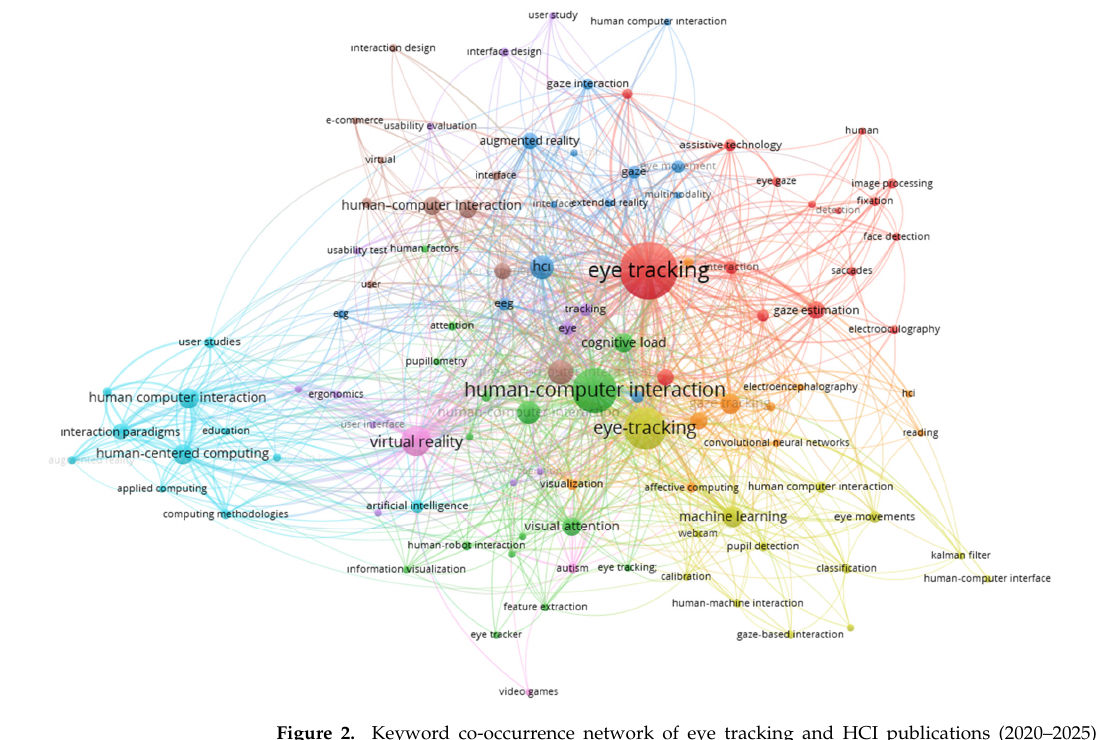
Four research axes (keyword co-occurrence). The keyword co-occurrence map places "eye tracking" as the dominant central node connecting all other themes, and resolves into four colour-coded clusters: a technical/algorithmic cluster (gaze estimation, deep learning, computer vision, image processing, multimodal interaction); an XR and interaction-paradigm cluster (virtual reality, augmented reality, human-centered computing, emotion recognition, serious games); a cognitive-load and human-factors cluster (cognitive load, attention, mental workload, working memory, reading, supervisory control); and a usability and interface-design cluster (usability, interface design, input devices, accessibility, pupil size, saccades) (PDF pp. 7–8, orig. pp. 7–8).
Collaboration and venues. The co-authorship network (54 researchers meeting a three-publication threshold) shows several medium-sized, densely connected groups — centred particularly in Europe (Germany, Finland) and Asia (China, South Korea) — linked by a few high-centrality bridging authors; technology-development and applied-HCI communities are partly separated (PDF pp. 8–9, orig. pp. 8–9). Output concentrates in computer-science series (Lecture Notes in Computer Science, Communications in Computer and Information Science) and open-access journals (IEEE Access, Sensors, Applied Sciences), while HCI-specific venues (CHI, Proceedings of the ACM on Human–Computer Interaction, ETRA) publish fewer papers but at higher citations per paper, marking them as core high-influence outlets (PDF pp. 9–10, orig. pp. 9–10). The most-cited single work in the dataset (151 citations) is Plopski et al.'s (2022) survey of gaze interaction and eye tracking in head-worn XR — already compiled here as Gaze Interaction In Extended Reality — followed by Ratcliffe et al.'s (2021) CHI survey of XR remote research (PDF pp. 9–10, orig. pp. 9–10).
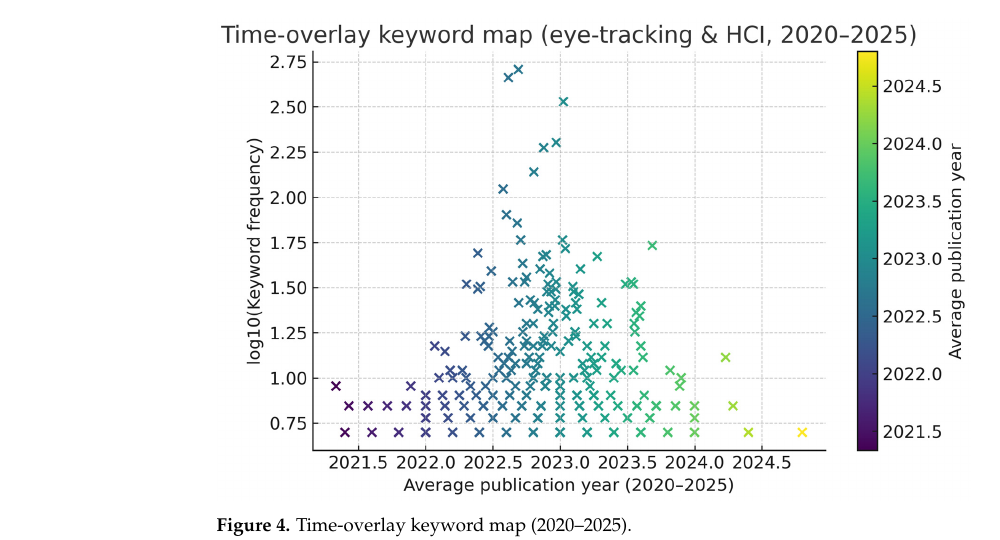
Temporal shift (time-overlay map). A time-overlay map of 361 keywords (each occurring at least five times), coloured by average publication year, divides the period into three phases: early themes around 2021 (surveys, information visualization, human–machine interface, pupillometry, e-commerce, data collection); a transitional phase in 2022–2023 (medical computing, wearable technology, navigation, education, cognitive performance); and emerging themes in late 2023–2024 (contrastive and adversarial machine learning, eye-controlled devices and cursor control, virtual environments, emotions, and augmentative and alternative communication) (PDF pp. 11–12, orig. pp. 11–12). The trajectory runs from core methods and survey accumulation, through application-domain diversification, to XR, advanced ML, and gaze-controlled interaction.
Content analysis of the 50 most-cited papers. These papers (2021–2024; 1718 citations, mean 34.4) group into themes led by XR and gaze-based interaction, with deep-learning gaze estimation second; further themes cover medical/clinical applications (gaze-coordinated robotic scrub nurses, digital-twin skull-base surgery, autism joint-attention VR), cognitive load and mental-state assessment (often fusing gaze with EEG, fNIRS, or heart-rate signals), educational and learning environments, multimodal interaction (gaze + gesture + speech), privacy and security (differential privacy for temporally correlated gaze data), industrial and commercial use, games and entertainment, and emerging hardware (transparent electrostatic interfaces, graphene-textile wearables, edge-computing trackers) (PDF pp. 11–14, orig. pp. 11–14). On the deep-learning axis, Korkmaz draws on dedicated surveys by Pathirana et al. (2022) and Ghosh et al. (2023), which report that convolutional architectures improve accuracy but degrade under occlusion, head pose, and inter-individual eye-shape variation (PDF pp. 2–3, 12, orig. pp. 2–3, 12).
Methodological gap. Because WoS and Scopus exports carry no device-level metadata (tracker type, sampling rate, calibration, spatial accuracy, data loss), the maps describe publication and topic structure, not eye-movement methodology, and Korkmaz explicitly avoids claims about optimal sampling rates or fixation definitions (PDF pp. 10–11, 16–17, orig. pp. 10–11, 16–17). Reading the most-cited papers, fixation-based measures, saccade metrics, and pupil-based indices dominate as primary outcomes, while scanpath entropy, transition matrices, and deviation-from-expert models appear rarely (PDF p. 16, orig. p. 16). The review identifies weak reporting of calibration, accuracy, and data-loss rates, and non-standardised event classification, as a persistent gap, and calls for harmonised reporting standards, open benchmark datasets, and privacy-preserving gaze analytics (PDF pp. 16–18, orig. pp. 16–18).
Conclusion
Korkmaz (2026) concludes that eye-tracking research in HCI is maturing in volume and content while shifting in character: from a primarily measurement-oriented technique toward an enabling technology that supports interaction design, cognitive assessment, accessibility, and user-centred system development. The four axes — deep-learning gaze estimation, XR interaction, cognitive/human factors, and usability/accessibility — are both prevalent and citation-influential, with survey and methodology papers acting as the field's intellectual backbone. The review positions XR as a prominent emerging application domain rather than a boundary of the field, and frames standardised evaluation protocols, benchmark datasets, ecologically valid (non-laboratory) studies, and privacy-aware gaze analysis as the priorities for the next phase. As a single-author bibliometric synthesis with single-coder thematic analysis, its cluster taxonomy should be read as an informed interpretive map rather than a definitive classification.
Related
- Gaze Interaction In Extended Reality
- Eye Tracking In Virtual Reality
- Appearance Based Gaze Estimation
- Pupil Dilation Cognitive Load
- Gaze Based Hci And Usability
- Fixation Saccade Detection
References
Bozkir, E., Özdel, S., Wang, M., David-John, B., Gao, H., Butler, K., Jain, E. & Kasneci, E. (2023) 'Eye-tracked virtual reality: a comprehensive survey on methods and privacy challenges', arXiv preprint arXiv:2305.14080. doi: 10.48550/arXiv.2305.14080. To be validated.
Ghosh, S., Dhall, A., Hayat, M., Knibbe, J. & Ji, Q. (2023) 'Automatic gaze analysis: a survey of deep learning based approaches', IEEE Transactions on Pattern Analysis and Machine Intelligence, 46(1), pp. 61–84. doi: 10.1109/TPAMI.2023.3321337. To be validated.
Korkmaz, A. (2026) 'Mapping eye-tracking research in human–computer interaction: a science-mapping and content-analysis study', Journal of Eye Movement Research, 19(1), 23. doi: 10.3390/jemr19010023. korkmaz2026mapping
Pathirana, P., Senarath, S., Meedeniya, D. & Jayarathna, S. (2022) 'Eye gaze estimation: a survey on deep learning-based approaches', Expert Systems with Applications, 199, 116894. doi: 10.1016/j.eswa.2022.116894. To be validated.
Plopski, A., Hirzle, T., Norouzi, N., Qian, L., Bruder, G. & Langlotz, T. (2022) 'The eye in extended reality: a survey on gaze interaction and eye tracking in head-worn extended reality', ACM Computing Surveys, 55(3), pp. 1–39. doi: 10.1145/3491207. plopski2022xr
Ratcliffe, J., Soave, F., Bryan-Kinns, N., Tokarchuk, L. & Farkhatdinov, I. (2021) 'Extended reality (XR) remote research: a survey of drawbacks and opportunities', in Proceedings of the 2021 CHI Conference on Human Factors in Computing Systems. ACM. doi: 10.1145/3411764.3445170. To be validated.
Sundstedt, V. & Garro, V. (2022) 'A systematic review of visualization techniques and analysis tools for eye-tracking in 3D environments', Frontiers in Neuroergonomics, 3, 910019. doi: 10.3389/fnrgo.2022.910019. To be validated.
Open Questions
- The four-axis taxonomy comes from a single coder reading 50 abstracts; an independent coding of the same corpus might partition the field differently. The clusters are an informed map, not a validated scheme.
- Bibliometric metadata cannot encode eye-movement methodology (sampling rate, calibration, data quality), so the review cannot confirm whether the apparent thematic convergence reflects methodological convergence. This is the same standardisation gap raised for surgery in Eye Tracking In Surgery and for VR/HMD benchmarks in QUESTIONS.md.
- The dataset uses an issue/early-access year of 2022 for Plopski et al. here (matching
plopski2022xr), whereas Korkmaz lists it as 2023; the discrepancy is an early-access vs. issue-date artefact for the same survey.