Ecological Interface Design in Social Systems
Status: emerging
Last updated: 2026-07-08
Sources: Burns Hajdukiewicz 2004 Ecological Interface Design.Pdf
Tags: [ecological-interface-design, social-systems, work-domain-analysis, abstraction-hierarchy, intentional-constraints, case-study]
Summary
Chapter 9 of Burns & Hajdukiewicz (2004) applies Ecological Interface Design (EID) to a social system — casino gambling — through a video poker display intended to correct problem gamblers' mental models. Social systems run on value, money, and experience rather than mass and energy, and the user is a participant in the system rather than an external controller, so the work domain had to be split into two conflicting parties: the house and the patron. The authors caution that EID is often not the right framework for social systems, which usually reward ease of use and experience, but that it fits where a system must explain or clarify a concept. The resulting display translated abstraction-hierarchy relationships into metaphor-based visualizations (a "dirty dog," an unfair race, a configural odds bar graph) rather than the conventional polar-star or bar-graph forms. The case shows both that value flows can be modeled much like physical flows and that entertainment-driven, multi-party domains stretch the method beyond its usual physically-constrained setting.
Body
Context
Burns & Hajdukiewicz (2004) devote Chapter 9 to social systems: domains oriented not to a physical product but to the exchange of goods and the delivery of experiences, such as stores, websites, and entertainment systems (PDF p. 274, orig. p. 239). The chapter sits within a book that otherwise teaches Work Domain Analysis (WDA) and display design through engineered domains, and it functions as a boundary case for the method introduced in Ecological Interface Design and the analytical tool described in Work Domain Analysis. The authors state plainly that EID is "probably not the best design framework" for most social systems, which are better served by a focus on ease of use and user experience, and that EID earns its place only when a system must explain or clarify a concept to its users (PDF p. 274, orig. p. 239). Social systems test the limits of a method built for physical constraints: their governing "laws" are social values — money, service, quality of experience — rather than conservation of mass and energy.
Key Points
Social systems differ from engineered systems in three structural ways. They do not necessarily obey physical principles and are instead driven by social values such as money, service, and quality of experience; the user is not merely a controller but a participant, and in a sense a component, because the system does not run as designed if the user stops shopping, gambling, or otherwise participating; and the design must produce a particular experience, such as entertainment, exploration, or discovery (PDF pp. 274–275, orig. pp. 239–240). Because the user sits inside the system, two interacting domains arise — the user's domain and the provider's domain — which the authors list as the three defining challenges of social systems: modeling money and value, modeling two tightly connected domains, and developing entertaining visualizations (PDF p. 275, orig. p. 240).
The system boundary was drawn to include the user, unlike the engineered cases. For casino gambling the boundary enclosed both the patron and the house, so that the interactions between them could be captured (PDF p. 276, orig. p. 241). This departs from the book's other systems, where the operator is deliberately left outside the boundary. Here the patron is included because the patron is the thing to be controlled: the design goal was to shape the patron's decision making, so the analysis was pitched one level higher than usual, treating the patron as an element within the system rather than as its external operator (PDF p. 276, orig. p. 241).
The abstraction hierarchy was split into two conflicting domains across all five levels. The house seeks profit while the patron seeks entertainment and winnings — the authors cite survey figures that 90% of problem gamblers gamble for entertainment and 84% gamble to win money — and these two conflicting functional purposes, attached to two distinct domain elements, produced a two-domain model spanning Functional Purpose, Abstract Function, Generalized Function, Physical Function, and Physical Form (PDF pp. 276–277, orig. pp. 241–242). At the Abstract Function level the domain was described not by physical conservation laws but by the flow of value: money flows from patron to house, the house acts as a "$ store" that must retain money at an increasing rate to make a profit, and the patron is a "$ source" and "$ sink." The patron's side was modeled with a "fun/cost" ratio that is ideally greater than 1 but decreases with time played, capturing the slide into problem gambling (PDF pp. 276–278, orig. pp. 241–243). This adaptation is the substantive move of the chapter: where an engineered abstraction hierarchy states physical laws at the Abstract Function level, here the level holds value relationships and an intentional constraint (the house's profit-retention rule) that the domain is deliberately built to satisfy.
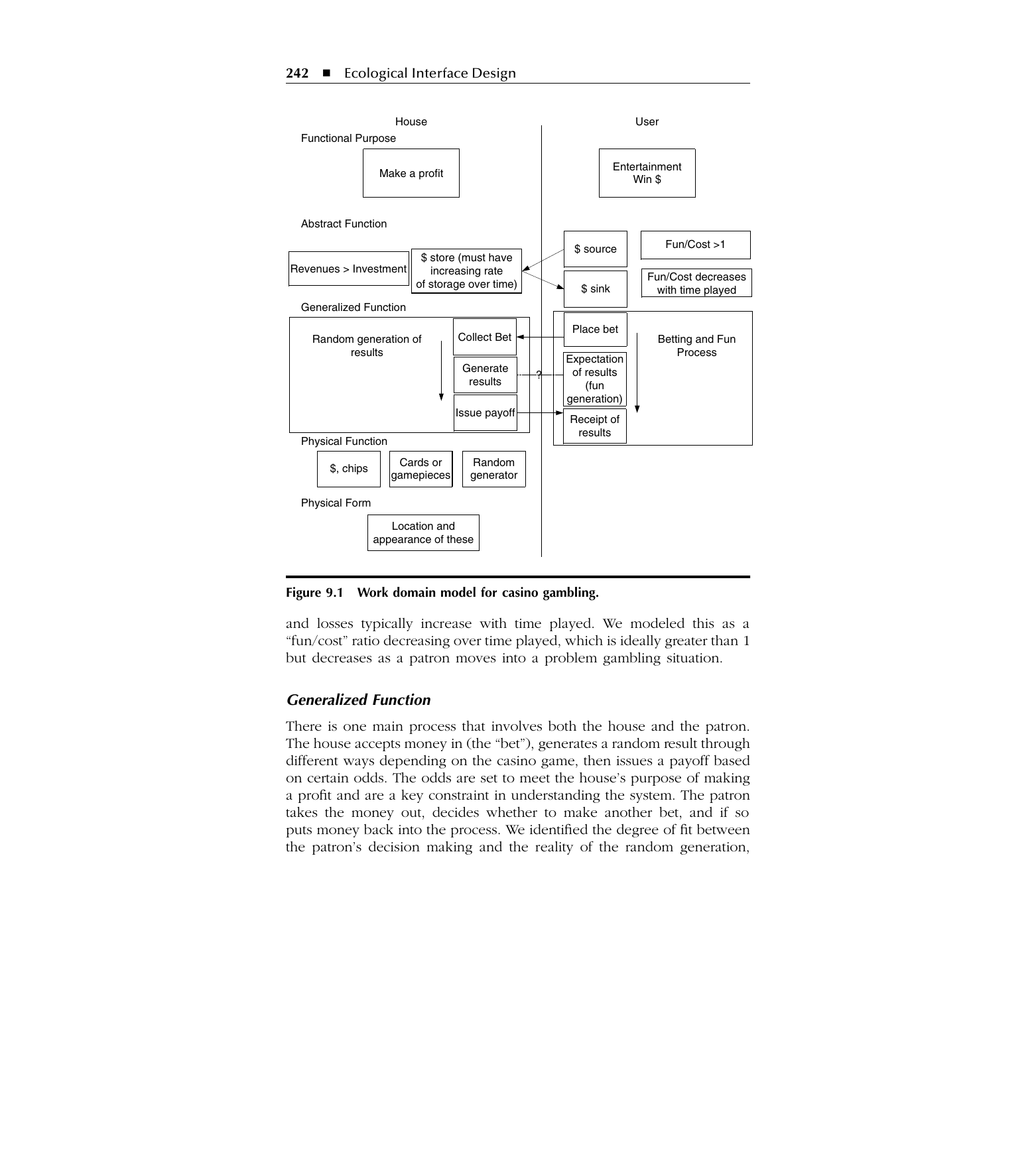
A single shared process links the two domains at the Generalized Function level. The house accepts a bet, generates a random result, and issues a payoff whose odds are set to secure the house's profit; the patron takes money out, decides whether to bet again, and if so returns money to the process (PDF pp. 278–279, orig. pp. 242–243). The odds are named as a "key constraint" in understanding the system, and the mismatch between the patron's decision making and the reality of random generation, probability, and odds-setting was identified as the target for the display design (PDF pp. 278–279, orig. pp. 242–243). At the Physical Function and Physical Form levels the components were money and value-bearing objects — cards, chips, a random generator, and, for Internet gambling, their virtual equivalents — together with their appearance and location (PDF p. 279, orig. p. 243).
The display translated model relationships into metaphor-based, entertaining visualizations. Conventional bar graphs and polar-star displays were judged unsuitable for an entertainment-driven system, so the model's constraints were re-expressed as metaphors that preserve the underlying display logic (PDF p. 288, orig. p. 247). A "downward spiral" set-up screen asks the patron how much money they are willing to lose and to set a time limit, showing that losses increase with play (Abstract Function); a trend chart along the bottom plots money against time with green, orange, and red regions for profit, losses within limits, and losses beyond limits (PDF pp. 279–280, orig. pp. 243–244). A "dirty dog" — adapted from the "PowerPig" power-consumption visualization by Kuk et al. (in Vicente 1998) — changes from a suave "cool dog" to a dog rummaging through trash once allowable losses are exceeded, serving as a Functional-Purpose status display equivalent to a polar star (PDF pp. 280–281, 288, orig. pp. 244–245, 247). An "unfair race" shows that the house always holds an advantage set by the odds, and a configural odds bar graph connects the winning and losing bars with a figure that slides down easily when winning chances are good and struggles upward when they are poor (PDF pp. 281, 284, orig. pp. 245, 246).
Evaluation was modest and mixed, and the limits of EID for social systems are stated directly. A usability test with engineering students was followed by review with two problem-gambling software experts; respondents generally judged the display useful, with the spiral time-limit analogy and the dog representation received well, though one expert did not initially grasp the configural odds display and the top-of-screen behavior-shaping representations were not implemented enough to yield valid results (PDF pp. 284–286, orig. pp. 246–247). The authors note that novices may need training to read novel graphics while experts recognize the underlying principles faster (PDF pp. 284–285, orig. p. 246). On the challenges, they conclude that money can be modeled much like a physical entity that moves and can be added or subtracted, but that once money is exchanged for goods or services the model must additionally describe what drives value — a transaction occurs only when the parties assess value differently — so balancing money really means tracking the flow of value (PDF pp. 286–287, orig. p. 247). The number of sub-models is decided by asking whether the parts of the domain can be physically isolated and exist without each other, and whether they hold different objectives; the two-party gambling model is likened to the earlier military frigate case, which used a three-part model for its three conflicting domains (PDF p. 287, orig. p. 247).
Conclusion
Social systems reveal EID's scope as bounded but extensible. The method transfers when a value flow can be modeled at the Abstract Function level and when the design goal is to make an obscured constraint — here, that the house is built to win — perceptually available. It strains when the domain has no physical law to anchor the abstraction hierarchy, when the user is inside rather than outside the system, and when the design must entertain rather than merely inform, forcing conventional ecological display forms to be recast as metaphors. The chapter's own verdict is that EID should be used selectively in social systems, as a supplement where a concept must be explained, not as the default framework.
Related
References
Burns, C.M. & Hajdukiewicz, J.R. (2004) Ecological Interface Design. Boca Raton, FL: CRC Press. burns2004ecological
Burns, C.M. & Proulx, P. (2002) 'Solving social problems through interface design', Ergonomics in Design, 10(4), pp. 10–16. To be validated
Kuk, G. et al., cited in Vicente, K.J. (1998) — "PowerPig" power-consumption visualization, referenced via Burns & Hajdukiewicz (2004). To be validated
National Council of Welfare (1996), cited in Burns & Hajdukiewicz (2004). To be validated
Open Questions
- How well do the metaphor-based visualizations (dirty dog, unfair race) preserve the perceptual mapping to work-domain constraints that conventional ecological displays claim, given that no controlled comparison against a polar-star or plain bar graph was reported?
- Would the two-domain, user-inside-the-boundary modeling generalize to other social systems named in the chapter — stores, websites, entertainment — or is it specific to adversarial domains with directly conflicting purposes?
- Does modeling an intentional constraint (the house's deliberately unfavorable odds) at the Abstract Function level fit Rasmussen's original conception of that level, or does it stretch the abstraction hierarchy beyond its physical-law foundation?