Ecological Interface Design
Status: emerging
Last updated: 2026-07-08
Sources: Burns Hajdukiewicz 2004 Ecological Interface Design.Pdf
Tags: [ecological-interface-design, work-domain-analysis, abstraction-hierarchy, cognitive-systems-engineering, display-design, srk-taxonomy, interface-design, representation-design]
Summary
Ecological Interface Design (EID) is an approach to designing interfaces for large, complex, safety-critical systems where expert users must engage in diagnostic problem solving (Burns & Hajdukiewicz, 2004). Rather than starting from user preferences, EID starts from the work domain: a Work Domain Analysis (WDA) built on Rasmussen's Abstraction Hierarchy maps the constraints of the environment being controlled, and the interface is then designed to make those constraints perceptually available. The aim is an interface that supports skill-, rule-, and knowledge-based behaviour, and that remains robust in unanticipated situations because it shows operators when a constraint has been broken.
Body
Context
Burns & Hajdukiewicz (2004), in their book-length applications text, examine how to design interfaces for complex systems — power plants, medical equipment, aircraft, telecommunications networks — by analysing the work domain first and displaying its constraints second. The book concentrates on method and application rather than theory, teaching Work Domain Analysis (WDA) and its translation into displays through worked case studies across transportation, process control, telecommunications, medical, and social systems. EID is presented as a supplement to, not a replacement for, other design approaches. Within this knowledge base the article is the primary-source anchor for a framework previously mentioned only in passing in Representation Design (Flach et al., 2021): where that article treats the general shift from information processing to meaning processing, EID gives the concrete analytical tool — the Abstraction Hierarchy — for surfacing work-domain structure. It connects to the cognitive-foundations material in Information Processing and Situation Awareness, and to the automation strand in Supervisory Control Of Automation, because EID was developed for exactly the supervisory, safety-critical settings those articles describe.
Key Points
EID targets a specific class of design problem. EID was developed for complex, safety-critical systems where expert users must engage in diagnostic problem solving, and where the work domain is large, highly interconnected, and has unpredictable dynamics (PDF pp. 37–38, orig. pp. 2–3). Design problems differ along the degree of diagnostic problem solving required, the complexity of the domain, the expected skill level of the user, and how safety-critical or time-dependent the work is. Unlike a car radio, whose layout can be settled by a focus group, the information requirements of a mechanic or an anaesthesiologist demand extensive study by the designer (PDF p. 38, orig. p. 3).
An "ecological" interface reflects work-environment constraints perceptually. An ecologically sound design reflects the constraints of the work environment in a way that is perceptually available to the people who use it, so that users can take effective action while understanding how those actions move them toward their objectives (PDF p. 36, orig. p. 1). When done well, complex relationships are visualised naturally and users feel they work directly with the object rather than with the interface — a transparency of use the authors call the "holy grail" of interface design (PDF pp. 36–37, orig. pp. 1–2).
EID answers three limits of purely user-centred design. Asking users what they need does not always work in complex systems, because users may not understand all the relationships behind the systems they operate and five users will give five different answers (PDF p. 41, orig. p. 6). EID adds value when the designer must understand how the system works before designing (PDF p. 42, orig. p. 7); when the goal is to help users become experts by encapsulating domain knowledge in the interface and shortening the learning curve (PDF pp. 40–41, orig. pp. 5–6); and when the system must handle the unexpected. Designing to specific scenarios risks an interface too rigid for novel situations, whereas designing to constraints covers unanticipated events: any break in a displayed constraint signals that an event is taking place and, at the same time, shows the operator how to act — restore the constraint (PDF pp. 42–43, orig. pp. 7–8).
EID grew out of cognitive engineering at Risø. The formal approach originated with Vicente and Rasmussen (1989), but its roots lie in control-engineering research at the Risø National Laboratory in Denmark from the 1960s, where Jens Rasmussen's work on nuclear-plant reliability shifted from hardware to human reliability and gave rise to cognitive engineering as a discipline (PDF pp. 43–44, orig. pp. 8–9). Two ideas came from this programme. The first is the Skill–Rule–Knowledge (SRK) taxonomy of operator behaviour: skill-based behaviour is automatic and neuromuscular; rule-based behaviour follows "if–then" inferences in proceduralised situations; knowledge-based behaviour requires reasoning about how and why the plant works, and is what is needed in unanticipated situations. An interface for complex systems must support all three (PDF p. 44, orig. p. 9). The second is the Abstraction Hierarchy: field studies of troubleshooters showed people reason by asking "how" and "why" — means–ends — questions, and these relationships assemble into a hierarchy that describes the system at successive levels of abstraction (PDF pp. 44–45, orig. pp. 9–10).
Work Domain Analysis starts from the environment, not the user. The book builds interfaces from a Work Domain Analysis, the approach that spawned interest in EID and whose theoretical motivation and method are set out by Vicente (1999) (PDF p. 37, orig. p. 2). WDA defines a system of interest by drawing a boundary around what the user controls or needs information on, while leaving out the interface, databases, and signal-acquisition equipment that should stay transparent — a doctor's work domain is the patient, not the records database (PDF pp. 48–49, orig. pp. 13–14). A WDA is an Abstraction Hierarchy carried out at various levels of detail set by a Part–Whole Hierarchy (PDF p. 48, orig. p. 13). The full method — the five levels, the Part–Whole Hierarchy, and the steps for building and using a model — is compiled in Work Domain Analysis and Wda In Design.
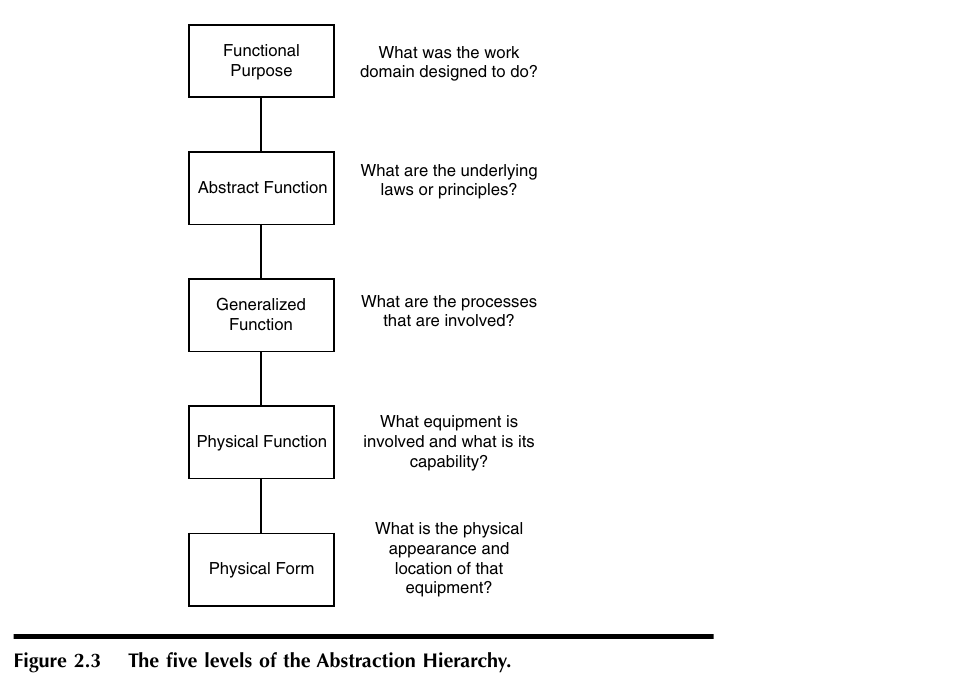
The Abstraction Hierarchy has five means–ends levels. Rasmussen's (1985) hierarchy describes a work domain at five levels, connected top-down by "how" and bottom-up by "why" (PDF pp. 51–52, orig. pp. 16–17):
- Functional Purpose — what the work domain was designed to do, stated generically and paired with evaluative criteria, often as two potentially conflicting purposes (e.g. transport people quickly and safely).
- Abstract Function — the causal laws and priorities that cannot be broken, typically conservation of mass and energy.
- Generalized Function — the processes that accomplish those mass/energy transformations.
- Physical Function — the equipment involved and its capabilities.
- Physical Form — the physical appearance and location of that equipment.
The Abstraction Hierarchy is identical to functional decomposition, except that functional decomposition happens before something is built whereas interface designers usually work with an "as-built" system, in effect re-creating the reasoning behind the original design (PDF p. 52, orig. p. 17).
From analysis to display: a visual language. The book pairs WDA with a "visual thesaurus" — a lookup of basic visual elements (bar graphs, meters, trend charts, connected bar graphs, and multivariate forms) mapped to the kind of variable and constraint a display must show (PDF pp. 82–83, orig. pp. 47–48). Design is treated as a learnable art: use the analysis to identify the variables to display and their key relationships, then structure the display, borrowing and adapting configural forms from existing designs and the book's case studies. The forms of reference and the full visual thesaurus are compiled in Interface Design Language.
The book chapter by chapter. This article is the overview hub; each chapter of Burns & Hajdukiewicz (2004) is compiled as its own article, so the case studies and method detail are held where they belong rather than in one page:
- Ch 2 — Work Domain Analysis — the five-level Abstraction Hierarchy and Part–Whole Hierarchy that model the controlled environment (orig. pp. 13–46).
- Ch 3 — Interface Design Language — forms of reference and the visual thesaurus mapping data relationships to display forms (orig. pp. 47–84).
- Ch 4 — Wda In Design — turning a work-domain model into laid-out ecological display graphics (orig. pp. 85–104).
- Ch 5 — Eid Transportation Systems — naval and aviation case studies: a frigate, a destroyer, the Harvard/HITS aircraft display, and the Hercules fuel-balance display (orig. pp. 105–140).
- Ch 6 — Eid Process Control — thermal and nuclear power, a pasteuriser, and petrochemical reactors, with mass-and-energy balance displays (orig. pp. 141–178).
- Ch 7 — Eid Telecommunications — network management and radio communication, built around a Mass Data Display overview (orig. pp. 179–200).
- Ch 8 — Eid Medical Systems — neonatal oxygenation, operating-room anaesthesia, and diabetes self-management displays (orig. pp. 201–238).
- Ch 9 — Eid Social Systems — a casino video-poker system, testing whether WDA transfers to social, intent-driven domains (orig. pp. 239–248).
- Ch 10 — Eid With Other Methods — how EID complements Cognitive Work Analysis, Task Analysis, Situation Awareness Analysis, and six further HCI/usability methods (orig. pp. 249–288).
Conclusion
Burns & Hajdukiewicz (2004) conclude that WDA is an effective way to understand a complex domain, and that its value grows with re-use as a "living" analysis that can also assess new technologies. EID is positioned as an effective addition to other design approaches rather than a standalone method: it determines work-domain constraints and provides a visual basis for displaying them, but the final measure of any design remains how well it supports human performance, which still demands the human-performance and usability testing that lie outside EID's own scope.
Related
- Work Domain Analysis
- Interface Design Language
- Wda In Design
- Eid Transportation Systems
- Eid Process Control
- Eid Telecommunications
- Eid Medical Systems
- Eid Social Systems
- Eid With Other Methods
- Representation Design
- Information Processing
- Situation Awareness
- Supervisory Control Of Automation
- Task Analysis
- Data Visualization
- Human Centred Design Maritime Domain
References
Burns, C.M. & Hajdukiewicz, J.R. (2004) Ecological Interface Design. Boca Raton, FL: CRC Press. burns2004ecological
Rasmussen, J. (1985) 'The role of hierarchical knowledge representation in decisionmaking and system management', IEEE Transactions on Systems, Man, and Cybernetics, SMC-15(2), pp. 234–243. To be validated.
Vicente, K.J. (1999) Cognitive Work Analysis: Toward Safe, Productive, and Healthy Computer-Based Work. Mahwah, NJ: Lawrence Erlbaum Associates. To be validated.
Vicente, K.J. & Rasmussen, J. (1989) 'Coping with human errors through system design: implications for ecological interface design', International Journal of Man-Machine Studies, 31(5), pp. 517–534. To be validated.
Open Questions
- How does the Abstraction Hierarchy transfer to interfaces for highly automated and AI-mediated work domains, where the "as-built" system includes autonomous agents?
- How do the constraint-based displays of EID relate to Endsley's situation-awareness levels covered in Situation Awareness — are they complementary or competing accounts of what a display should surface?
- The book predates modern touch and mobile interfaces; how well does the visual thesaurus map onto small-screen and interaction-rich displays?