Using EID with Other Methods
Status: emerging
Last updated: 2026-07-08
Sources: Burns Hajdukiewicz 2004 Ecological Interface Design.Pdf
Tags: [ecological-interface-design, user-centered-design, usability, task-analysis, design-process, methods-integration]
Summary
Chapter 10 of Burns and Hajdukiewicz (2004) positions Ecological Interface Design (EID) alongside other human-computer interaction and usability methods rather than as a self-sufficient design procedure. Each method is placed on a shared framework whose columns are the elements of the work environment (work domain, activities, people and technology) and whose rows are the stages of the interface lifecycle (information requirements generation, interface design, evaluation). EID is shown to concentrate on the work-domain column and the information-requirements row; the chapter walks through nine methods — Cognitive Work Analysis, Task Analysis, Situation Awareness Analysis, Contextual Inquiry, GOMS, Use Case scenarios, Participatory Design, user interface design principles, and Usability Evaluation — placing each on the framework and comparing it with EID. The authors argue that no single method answers the interface-design question for real complex systems, so effective practice combines EID with complementary techniques. The chapter uses the DURESS II process-control microworld as a running example for every method.
Body
Context
Burns and Hajdukiewicz (2004) devote the concluding analytical chapter of Ecological Interface Design to the question of how EID relates to the wider set of methods a design team already uses. The chapter examines a selection of established human-centered methods, describes each with a DURESS II example, discusses where each complements or diverges from EID, and maps each onto a common design framework. EID itself is treated in depth in Ecological Interface Design and rests on work domain analysis (see Work Domain Analysis and Wda In Design). Several of the methods discussed here have their own coverage in this knowledge base, including Task Analysis and User Requirements Methods. The chapter's purpose is integrative: to locate EID within a design process rather than to advance the method on its own terms.
Key Points
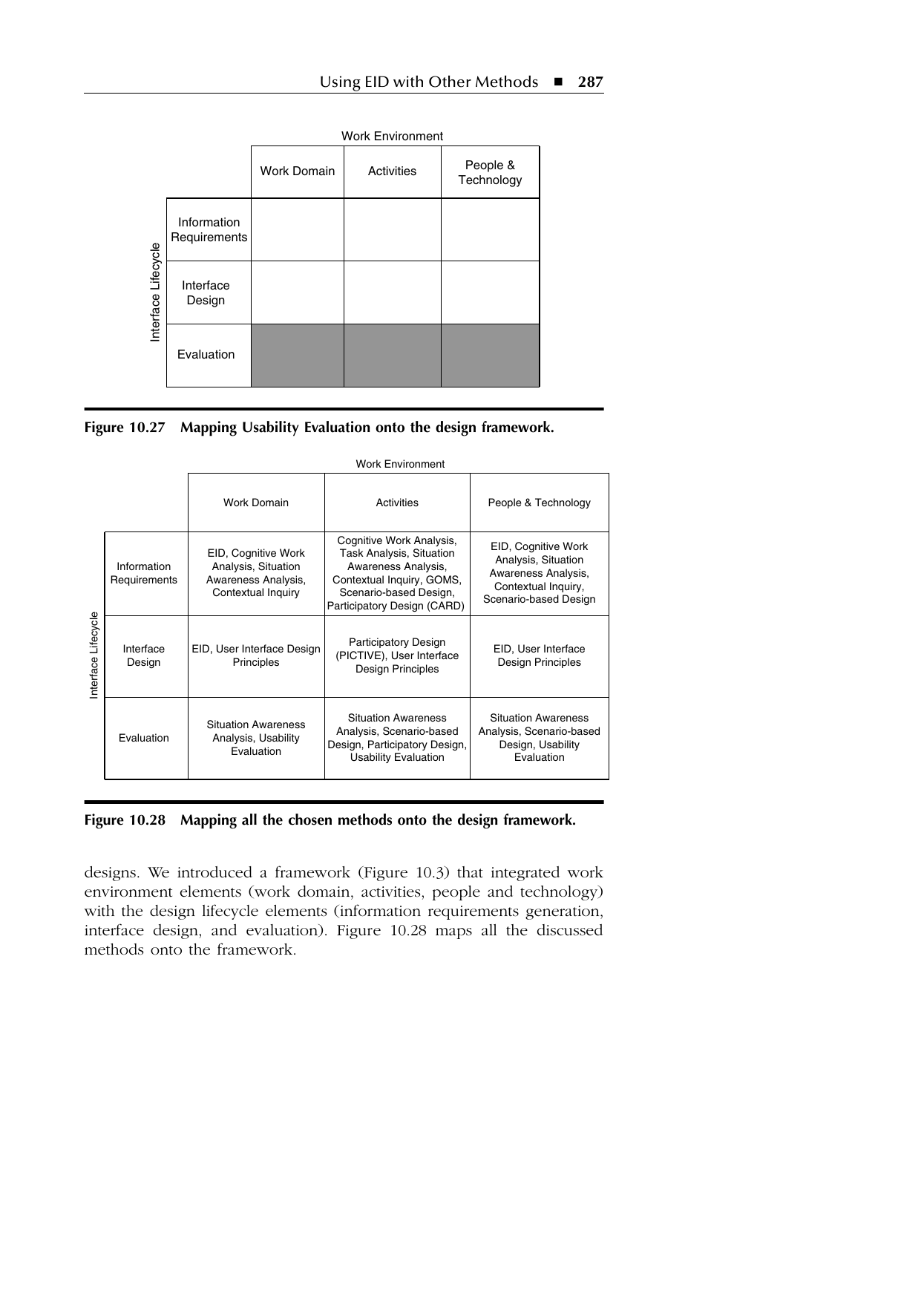
A shared framework locates every method. The chapter organises its comparison around a two-dimensional framework whose columns are the three elements of the work environment — work domain, activities, and people and technology — and whose rows are the three stages of the interface lifecycle — information requirements, interface design, and evaluation (PDF pp. 284–286, orig. pp. 249–251; framework summarised PDF p. 322, orig. p. 287). Each method is discussed and then shaded onto the cells it covers, which makes the coverage gaps between methods visible.
Cognitive Work Analysis is the closest relative but broader in scope. Cognitive Work Analysis (Rasmussen et al. 1994; the account here follows Vicente 1999) analyses complex socio-technical systems through five phases — work domain, control tasks, strategies, social organisation and cooperation, and competencies — each with its own modelling tool, from the Abstraction Hierarchy for the work domain to the decision ladder for control tasks and the skills-rules-knowledge framework for competencies. It shares tools with EID, the Abstraction Hierarchy among them, but is the more general framework: it fills in the activity and action dependencies and the social-organisational constraints that EID sets aside, while EID gives more direct links to interface design. On the framework, work domain analysis maps to the work-domain column, control tasks and strategies to activities, competencies to people and technology, and social organisation and cooperation across all three, all within the information-requirements row (PDF pp. 292–296, orig. pp. 257–261).
Task Analysis models the actions that connect states to goals. Task Analysis centres on modelling user or actor actions in the context of goals, and appears in several forms — sequential, timeline, hierarchical, cognitive, and the control task analysis used within Cognitive Work Analysis (Kirwan and Ainsworth 1992; Militello and Hutton 1998). Hajdukiewicz and Vicente (forthcoming) frame the relationship between work domain analysis and task analysis as five discrete transformations from the complete work-domain structure to a final set of actions and states, along which the degrees of freedom in control fall while time- and context-dependence rise. Task Analysis sits in the information-requirements row, addressing activities and the people and technology that perform them; it considers environmental constraints only indirectly and does not formally model them, which is the gap EID fills (PDF pp. 296–300, orig. pp. 261–265).
Situation Awareness Analysis specifies what a display must surface to keep operators aware. Situation Awareness — the integrated perception, comprehension, and projection of a dynamic situation relative to goals — is treated across Endsley's three levels (Endsley and Garland 2000; Endsley 2000), with assessment methods including SAGAT, SART, SA-SWORD, and SARS. Applied heuristically to the DURESS II microworld, the EID interface supports Level 1 through consistent perceptual cues (a straight line signalling steady-state mass balance), Level 2 by showing constraints and their links to system goals directly on the display, and Level 3 only in a limited way, since instantaneous derivative information supports short-range prediction but unanticipated events cannot be forecast. Situation Awareness is complementary to EID, supplying principles for what to display and how, and maps onto the information-requirements and evaluation rows (PDF pp. 300–303, orig. pp. 265–268).
Contextual Inquiry addresses the socio-technical structure that EID sets aside. Contextual Inquiry (Beyer and Holtzblatt 1998) analyses the immediate work environment together with organisational and cultural influences through physical, sequence, cultural, flow, and artifact models. EID does not treat the socio-technical structure at this level of detail because it concentrates on the work domain to be controlled, so the two methods are complementary. On the framework, Contextual Inquiry maps mainly onto the information-requirements row across all three work-environment elements (PDF pp. 307–308, orig. pp. 272–273).
GOMS models efficient, skilled activity but not work-domain function. GOMS (Goal, Operators, Methods, Selection Rules; Card et al. 1983) decomposes tasks into timed perceptual, cognitive, and motor operators and is effective at modelling predictable, efficient task execution. Its limits are that it applies to skilled rather than novice users, does not represent learning or recall after disuse, and does not address work-domain functionality; EID, by contrast, supports both novice and expert behaviour and displays the functional structure of the domain. GOMS maps onto the information-requirements / activities cell (PDF pp. 308–310, orig. pp. 273–275).
Use Case scenarios describe activity and context, not domain function. Use Case scenarios (Carroll 1995) describe user-interaction episodes in enough detail to drive design and usability decisions, capturing contextual information, motivations, and organisational influences in narrative, storyboard, video, or prototype form. They do not model the functional structure of the work domain explicitly, and they fall primarily on the information-requirements and evaluation rows of the framework (PDF pp. 310–312, orig. pp. 275–277).
Participatory Design captures activities efficiently through user involvement. Participatory Design (Muller et al. 1992) places active workplace practitioners at the centre of assessment, design, and decision-making; the CARD technique combines storyboarding with card-based games, and PICTIVE uses known objects to represent system components down to display-design detail (Muller et al. 1995). These methods produce results quickly and cover the activities element across the whole interface lifecycle, though the outputs are often not detailed models. EID, in contrast, concentrates on information requirements and work-domain modelling to create displays (PDF pp. 312–314, orig. pp. 277–279).
User interface design principles bridge from requirements to graphic form. Once information requirements exist, established interface principles — consistency, an upper-left starting point, navigation matched to workflow, visually pleasing composition, Gestalt grouping, calibrated amount of information (invoking Miller's 7±2 limit), meaningful ordering, distinctiveness, and focus and emphasis — guide how requirements become organised display elements (Galitz 1997; Horn 1998). EID generates and structures the requirements and constrains the graphic forms; the principles fill the remaining gaps and map onto the interface-design stage across all work-environment elements (PDF pp. 314–317, orig. pp. 279–282).
Usability Evaluation supplies the evaluative stage EID needs. Usability Evaluation (Nielsen 1993) is a user-centered, user-driven method aimed mainly at evaluating a completed design against nine usability areas (terminology, workflow, navigation, symbols, access, content, format, functionality, organisation) and criteria such as visual clarity, consistency, compatibility, informative feedback, explicitness, appropriate functionality, flexibility and control, error prevention and correction, and user guidance. It does not generally generate information requirements but feeds back their appropriateness after user testing, so it is complementary to EID, which requires an evaluative element within its lifecycle. Usability Evaluation maps onto the evaluation row (PDF pp. 317–322, orig. pp. 282–287).
No single method is sufficient. The chapter concludes that it is unlikely EID, or any other single method, will efficiently answer the interface-design question for real, complex environments; other methods are required to fill the gaps, and EID in turn fills gaps left by others — for example, the Abstraction Hierarchy is offered as an alternative to some Contextual Inquiry models (PDF p. 323, orig. p. 288).
Conclusion
The chapter treats EID as a complement to existing human-centered methods rather than a replacement for them. EID contributes an analysis of work-domain constraints and a visual basis for displaying that information, concentrated on the work-domain element and the information-requirements stage. The most effective designs combine EID with methods that capture the other work-environment elements and lifecycle stages, and the authors note that measuring how well a design supports human performance still demands human-performance and usability testing that lie outside the focus of EID (PDF pp. 322–323, orig. pp. 287–288).
Related
- Ecological Interface Design
- Work Domain Analysis
- Task Analysis
- Situation Awareness
- User Requirements Methods
References
Beyer, H. & Holtzblatt, K. (1998) Contextual Design: Defining Customer-Centered Systems. San Francisco: Morgan Kaufmann. To be validated
Burns, C.M. & Hajdukiewicz, J.R. (2004) Ecological Interface Design. Boca Raton, FL: CRC Press. burns2004ecological
Card, S.K., Moran, T.P. & Newell, A. (1983) The Psychology of Human-Computer Interaction. Hillsdale, NJ: Lawrence Erlbaum Associates. To be validated
Carroll, J.M. (ed.) (1995) Scenario-Based Design: Envisioning Work and Technology in System Development. New York: John Wiley & Sons. To be validated
Endsley, M.R. (2000) 'Theoretical underpinnings of situation awareness: a critical review', in Endsley, M.R. & Garland, D.J. (eds.) Situation Awareness Analysis and Measurement. Mahwah, NJ: Lawrence Erlbaum Associates. To be validated
Endsley, M.R. & Garland, D.J. (eds.) (2000) Situation Awareness Analysis and Measurement. Mahwah, NJ: Lawrence Erlbaum Associates. To be validated
Galitz, W.O. (1997) The Essential Guide to User Interface Design: An Introduction to GUI Design Principles and Techniques. New York: John Wiley & Sons. To be validated
Hajdukiewicz, J.R. & Vicente, K.J. (forthcoming) 'A theoretical note on the relationship between work domain analysis and task analysis', Theoretical Issues in Ergonomics Science. To be validated
Horn, R.E. (1998) Visual Language: Global Communications for the 21st Century. Bainbridge Island, WA: MacroVU. To be validated
Kirwan, B. & Ainsworth, L.K. (eds.) (1992) A Guide to Task Analysis. London: Taylor & Francis. To be validated
Militello, L.G. & Hutton, R.J.B. (1998) 'Applied cognitive task analysis (ACTA): a practitioner's toolkit for understanding cognitive task demands', Ergonomics, 41(11), pp. 1618–1641. To be validated
Muller, M.J., Kuhn, S. & Meskill, J.A. (eds.) (1992) PDC'92: Proceedings of the Participatory Design Conference. Cambridge, MA: Computer Professionals for Social Responsibility. To be validated
Muller, M.J., Tudor, L.G., Wildman, D.M., White, E.A., Root, R.W., Dayton, T., Carr, R., Diekmann, B. & Dykstra-Erickson, E. (1995) 'Bifocal tools for scenarios and representations in participatory activities with users', in Carroll, J.M. (ed.) Scenario-Based Design: Envisioning Work and Technology in System Development. New York: John Wiley & Sons, pp. 135–163. To be validated
Nielsen, J. (1993) Usability Engineering. San Diego: Academic Press. To be validated
Rasmussen, J., Pejtersen, A.M. & Goodstein, L.P. (1994) Cognitive Systems Engineering. New York: John Wiley & Sons. To be validated
Vicente, K.J. (1999) Cognitive Work Analysis: Toward Safe, Productive, and Healthy Computer-Based Work. Mahwah, NJ: Lawrence Erlbaum Associates. To be validated
Open Questions
- How should a design team sequence EID relative to Contextual Inquiry and Participatory Design when both offer information-requirements coverage for overlapping work-environment elements?
- The chapter asserts complementarity between EID and Usability Evaluation but offers no empirical case in which the two were combined on one project; what evidence exists that the combination outperforms either method alone?
- Where the framework shows two methods mapped onto the same cell (for example EID and Contextual Inquiry on work-domain information requirements), what criteria should determine which method is preferred for a given domain?