Platform–Ship Collisions on the Norwegian Continental Shelf (2001–2010)¶
Status: emerging
Last updated: 2026-06-16
Sources: Kvitrud 2011 Platform Ship Collisions Norway.Pdf
Tags: [collision, offshore-platform, dynamic-positioning, norwegian-continental-shelf, maritime-safety, ship-operations, accident-analysis, supply-vessel, shuttle-tanker, safety-zone, human-error, watchkeeping]
Summary¶
Kvitrud (2011), writing for the Norwegian Petroleum Safety Authority (PSA), reviews collisions between ships and offshore installations on the Norwegian Continental Shelf. Of 115 collisions reported since 1982, 26 fell in 2001–2010; none caused loss of life or personal injury, but economic damage was significant, above all the 2009 Big Orange XVIII striking of Ekofisk 2/4-W. The paper pairs long-run statistics with detailed accounts of the six most severe cases of the decade and identifies a recurring set of human and organisational causes: procedures not followed inside the 500 m safety zone, over-reliance on autopilot and dynamic positioning (DP), inadequate crew training and high turnover, and schedule pressure. Within this knowledge base it is the offshore-operations and collision-risk source, complementing the human-element accident analyses in Situation Awareness Maritime Accidents and Simultaneous Tasks Maritime Accidents.
Body¶
Context¶
Kvitrud (2011) examines collisions between visiting vessels and fixed or mobile offshore installations on the Norwegian Continental Shelf, drawing on PSA incident records, operator investigation reports, and design-standard requirements. The method is descriptive and statistical rather than experimental: long-run collision counts and vessel-size trends are set beside close readings of the decade's six most onerous cases (PDF p. 1, orig. p. 1). The paper sits in this knowledge base as the ship-operations and offshore-safety source. Its causal findings — autopilot and DP left engaged, watchkeeping lapses, and schedule pressure — connect to the situation-awareness failures catalogued in Situation Awareness Maritime Accidents, the workload and crewing pressures in Simultaneous Tasks Maritime Accidents, and the end-of-shift and fatigue effects in Seafarer Fatigue.
Key Points¶
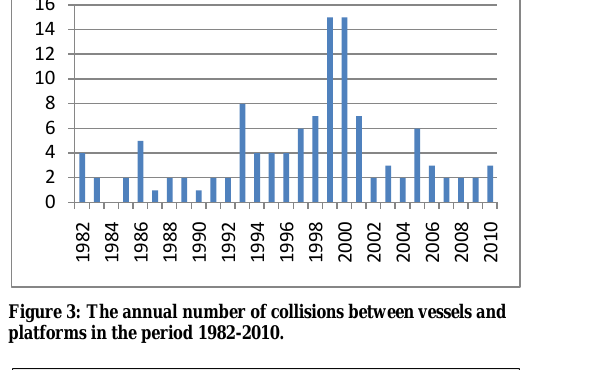
Across the long run, 115 collisions were reported on the shelf since 1982 and 26 in 2001–2010, with no fatalities or personal injuries but significant economic loss, especially one 2009 event (PDF p. 1, orig. p. 1). The annual series shows a marked peak around 2000 and a generally lower level through the late 2000s (Figure 1). Passing-vessel collisions are rare — only two in the record, a submarine against the Oseberg B jacket (1988) and a vessel against the H-7 booster platform (1995) — so almost all collisions involve vessels visiting the installation, and the normalised number of vessels on a collision course (Sandsli data) improved roughly fourfold after 2002 (PDF p. 2, orig. p. 2).
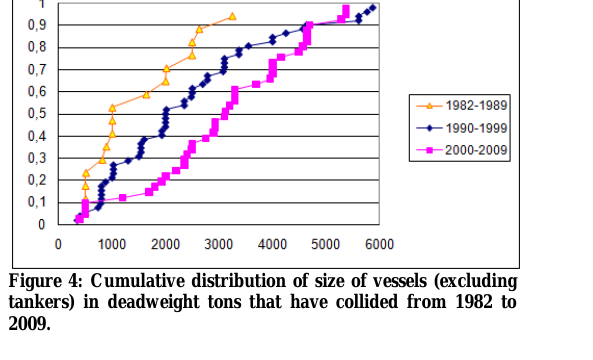
The severity of the threat has nonetheless risen. The average size of colliding vessels (excluding tankers) grew by about 100 tons per year since the 1980s, and because impact energy scales with mass, a typical vessel can now do far more damage than two decades earlier (PDF p. 2, orig. p. 2; Figure 2). Collision frequency varies sharply by installation type: field centres and mobile platforms have the highest frequencies, fixed manned production platforms the lowest, with no trend by time of day or season and no correlation between technical-failure collisions and vessel age (PDF p. 2, orig. p. 2).
The regulatory and design framework defines the tolerable envelope. PSA's activity regulation §90 requires measures to hold vessel and facility position during marine operations, and the facility regulation §11 requires accidental loads with annual probability ≥ 1×10⁻⁴ not to defeat a main safety function (PDF p. 1, orig. p. 1). NORSOK N-003 sets the design collision at a supply ship of normally ≥ 5000 tons at 0.5 m/s (ULS) and 2 m/s (ALS), with added hydrodynamic mass of 40 % sideways and 10 % bow/stern; shuttle tankers loading from hydrocarbon facilities such as FPSOs require DP equipment class 2 under IMO/MSC Circular 645 (PDF p. 1–2, orig. p. 1–2). Most installations are monitored from shore-linked traffic centres at Ekofisk (ConocoPhillips) and Sandsli (Statoil), with the Ekofisk centre duplicated to a Tananger shore base in 2010 (PDF p. 1, orig. p. 1).
The six most severe cases of the decade share a small set of failure modes (PDF p. 3–4, orig. p. 3–4). Far Symphony hit the semi-submersible West Venture (2004) at 3.7 m/s — about 39 MJ — while on autopilot with a crew unaware the autopilot was engaged. Ocean Carrier struck the Ekofisk 2/4-P bridge (2005) in dense fog with unclear command responsibility at handover (energy > 20 MJ). The shuttle tanker Navion Hispania black-out while connecting to the Njord B FSU (2006) after contaminated fuel clogged its filters (≈ 61 MJ). Bourbon Surf hit the Grane jacket (2007) after both officers left the bridge and the platform was used as an autopilot waypoint. The decade's worst, Big Orange XVIII against the unmanned water-injection platform Ekofisk 2/4-W (2009), occurred with the autopilot never deactivated; the vessel narrowly missed three other installations and a flotel before striking 2/4-W at about 4.5–4.8 m/s (≈ 70 MJ), pushing it off position, failing braces, and forcing a production shutdown and the platform's planned removal. Far Grimshader fouled its propeller in an anchoring wire beside the semi Songa Dee (2010) and struck it repeatedly over roughly two hours before being towed clear.
Synthesising the cases, the common underlying causes (after Hope & Vikse 2000, modified by the author) are a weak safety culture with procedures not followed; sophisticated bridge equipment operated by inadequately trained crews who over-rely on autopilot and DP and correct errors too slowly; high personnel turnover and inexperienced navigators; and tight sailing schedules with little recovery, so risk-taking and end-of-shift collisions recur (PDF p. 4–5, orig. p. 4–5). The author adds that platform owners monitor vessels entering the safety zone insufficiently, and that equipment is often poorly adjusted to its users with inadequate barriers.
Conclusion¶
Kvitrud (2011) concludes that although total collision numbers improved after the 1998–2001 period, serious incidents rose across 2004–2010 and several could have been far worse, which keeps platform–ship collision a live risk on the shelf (PDF p. 5, orig. p. 5). Under PSA's function-based regulatory philosophy the responsible parties own the risk on their own vessels and installations; PSA's response is statistical follow-up, formal inquiries (notably the 2009 Big Orange investigation), and a request to the standardisation body to review the NORSOK N-003 collision requirements in light of the rising size and energy of colliding vessels. The repeated thread — autopilot or DP left engaged while attention lapsed — places the paper alongside the automation-overreliance and situation-awareness concerns running through Situation Awareness Maritime Accidents.
Related¶
- Situation Awareness Maritime Accidents
- Simultaneous Tasks Maritime Accidents
- Seafarer Fatigue
- Mass Regulatory Scoping Exercise
References¶
Kvitrud, A. (2011) 'Collisions Between Platforms and Ships in Norway in the Period 2001-2010', in Proceedings of the ASME 2011 30th International Conference on Ocean, Offshore and Arctic Engineering (OMAE2011), Rotterdam, The Netherlands, 19–24 June 2011, paper OMAE2011-49897, pp. 1–5. doi: 10.1115/OMAE2011-49897. kvitrud2011collisions
Hope, B. and Vikse, T. (2000) cited in Kvitrud (2011); original report on causes of supply-vessel collisions not held in RAW. To be validated
Open Questions¶
- The paper attributes most collisions to autopilot/DP over-reliance and watchkeeping lapses but reports no formal human-factors coding of the case set; a structured causal taxonomy (e.g. against the SA levels in Situation Awareness Maritime Accidents) would let the offshore cases be compared with the merchant-fleet accident corpus.
- Collision energies in the severe cases (39–70 MJ) repeatedly exceed the NORSOK N-003 design collision (5000 t at 2 m/s); whether the standard has since been revised is unresolved in this corpus.
- The shore-based traffic centres at Ekofisk, Sandsli, and Tananger are a remote-supervision function; their design and effectiveness belong to remote-operations-kb and are not yet connected here.