Seafarer Fatigue
Status: emerging
Last updated: 2026-06-15
Sources: Jepsen 2015 Seafarer Fatigue Review
Tags: [seafarer-fatigue, human-element, maritime-safety, shift-work, watchkeeping, sleep, fatigue-mitigation, occupational-health, stcw, maritime-labour-convention]
Summary
Fatigue at sea is a progressive loss of mental and physical alertness driven by the conditions of shipboard work — irregular shifts, broken and mistimed sleep, noise, motion, and high workload. Jepsen, Zhao and van Leeuwen (2015) review its causes and consequences and find that fatigue contributes both to acute safety failures (groundings, collisions, falling asleep on watch) and, through circadian and metabolic disruption, to chronic disease that is unusually prevalent among seafarers. Because several of the conditions at sea cannot be removed, the authors conclude that no single measure eliminates fatigue: mitigation requires regulation and compliance, adequate manning, company action, and individual sleep management together, supported by fatigue prediction tools.
Body
Context
Jepsen, Zhao and van Leeuwen (2015) present a narrative review in International Maritime Health of the risk factors for seafarer fatigue, its short- and long-term consequences for health and safety, and the options for mitigating it. Because seafarer-specific studies are limited, they draw on shift-work and transport research from other populations where the exposures match. Within this knowledge base the article anchors the occupational-health and physiological side of the human element, complementing the cognitive account in Situation Awareness Maritime Accidents and the socio-cultural workload account in Simultaneous Tasks Maritime Accidents; the manning thread also connects to the "remote operator as seafarer" question raised in Mass Regulatory Scoping Exercise.
Key Points
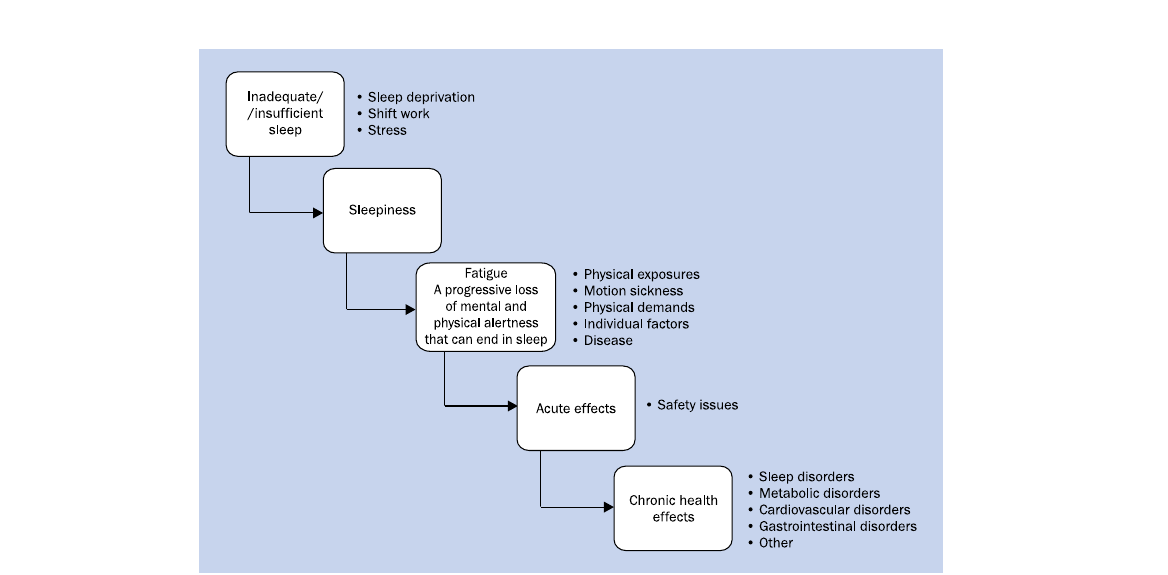
Defining and measuring fatigue. The IMO defines fatigue as "a reduction in physical and/or mental capability as the result of physical, mental or emotional exertion, which may impair nearly all physical abilities"; the authors propose the working definition "a progressive loss of mental and physical alertness possibly ending in sleep" (PDF p. 1, orig. p. 106). No universal measure exists. Subjective sleepiness is rated with the Karolinska Sleepiness Scale, while actigraphy and polysomnography give more objective sleep measures, and dedicated instruments such as the Multidimensional Fatigue Inventory (MFI-20) capture fatigue dimensions; under-recording of working hours, driven by cultural and commercial pressure, complicates measurement at sea (PDF pp. 1–2, orig. pp. 106–107).
Risk factors — work, sleep, and watch systems. Work at sea combines multiple risk factors: poor sleep quality, long and irregular hours, time-zone crossings, job demands, and stress. While most adults need 7–9 hours of sleep in a single night-time period, shift work breaks sleep into shorter, mistimed episodes of lower recuperative value (PDF p. 4, orig. p. 109). Watch system matters: fatigue is more pronounced in two-watch systems such as 6-on/6-off than in three-watch systems such as 4-on/8-off, and is worst between 04:00 and 06:00 when biological sleep pressure peaks; in one study of bridge officers 17.6% had fallen asleep on duty at least once during their career (PDF p. 4, orig. p. 109). The HORIZON project, using linked simulators and polysomnography, confirmed that 6-on/6-off induced more sleepiness than 4-on/8-off, with watchkeepers obtaining only about 6.5 hours of sleep split across two sessions — less than required for full rest (PDF pp. 4–5, orig. pp. 109–110).
Physical and individual factors. Engine noise, vibration, and ships' motion interrupt sleep, and motion sickness — experienced by most seafarers — is itself a major cause of fatigue (PDF p. 5, orig. p. 110). Individual susceptibility varies, and ageing, relevant to an ageing maritime workforce, slows circadian adaptation to night work and raises chronic-disease risk; work-related fatigue accumulates over continuous time on board (PDF pp. 5–6, orig. pp. 110–111).
Acute consequences — safety. Fatigue and sleepiness impair cognition and cause seafarers to fall asleep on duty. Retrospective casualty data link fatigue to maritime accidents: a US Coast Guard study of 279 incidents estimated fatigue contributed to 16% of critical vessel casualties and 33% of personal injuries, and a UK Marine Accident Investigation Branch study of 1,647 events found that a third of all groundings involved a fatigued officer alone on the bridge at night and that two-thirds of vessels involved in collisions were not keeping a proper lookout (PDF p. 6, orig. p. 111). Accident risk rises at night, increases across a series of shifts, and grows as shifts exceed eight hours (PDF p. 6, orig. p. 111).
Chronic consequences — health. Repeated or unrecovered fatigue acts through metabolic, autonomic, and immunological pathways. Chronic sleep debt disrupts circadian immune regulation and raises cardiovascular risk; shift work is a significant risk factor for coronary heart disease, peptic ulcer and irritable-bowel symptoms, raised blood pressure, obesity, and type 2 diabetes, and metabolic syndrome is more prevalent among seafarers than in the general population (PDF pp. 6–7, orig. pp. 111–112). The International Agency for Research on Cancer classifies shift work as a probable human carcinogen, with prostate carcinoma particularly implicated in men, and psychiatric conditions such as major depression are increased among shift workers (PDF p. 7, orig. p. 112). The authors note repeatedly that, despite plausible mechanisms, compelling causal evidence for several of these disease links remains to be established (PDF pp. 6–7, orig. pp. 111–112).
Mitigation — regulation, company, and individual. Securing sufficient quality sleep is the primary countermeasure. International regulation sets limits: ILO Convention 180 (in force 2002) caps work at 14 hours in any 24-hour period and 72 hours in any 7 days, with minimum rest of 10 hours per 24 and 77 hours per 7 days; the Maritime Labour Convention 2006 sets similar limits, while STCW and the ISM Code place obligations on alertness, manning, and company intervention (PDF pp. 7–8, orig. pp. 112–113). Manning is central: a comparison of an 18-man and a 24-man crew found the smaller crew worked longer hours with higher catecholamine excretion and stress, and under-recording of hours leaves under-reporters more fatigued and less healthy (PDF p. 8, orig. p. 113). At the individual level, cool, dark, quiet single cabins, sleep hygiene, daylight exposure, short naps of 15–40 minutes, caffeine and blue-light timing all help, though the authors do not recommend over-the-counter melatonin or hypnotics because side effects may outweigh benefit (PDF pp. 8–9, orig. pp. 113–114). Fatigue prediction models are now regarded as appropriate elements of a fatigue risk management system, though current models omit individual and task variables (PDF p. 9, orig. p. 114).
Conclusion
Jepsen, Zhao and van Leeuwen (2015) conclude that fatigue is frequent and consequential at sea, contributing to accidents acutely and to chronic disease over a career, yet several conditions that cause it — shifts, time-zone crossings, weather, and motion — cannot be altered. They argue that collective mitigation cannot stand alone and that no combination of countermeasures eliminates the physiological effects of shift work; the realistic path is layered defence — sound regulation and genuine compliance, adequate and honestly recorded manning, company-level strategy under the ISM Code, individual sleep management, and maturing fatigue prediction and risk-management tools — with lessons drawn from aviation and other fatigue-prone sectors.
Related
- Situation Awareness Maritime Accidents — fatigue is a recognised contributor to the loss of situation awareness that causes casualties; the physiological counterpart to that cognitive failure
- Simultaneous Tasks Maritime Accidents — shares insufficient crewing and excessive workload as drivers; multitasking and fatigue are parallel consequences of the same manning and work-design pressures
- Mass Regulatory Scoping Exercise — manning, hours-of-rest, and the "remote operator as seafarer" questions bear directly on how fatigue regulation transfers to autonomous and remotely-operated ships
References
International Maritime Organization (2002) Guidelines on Fatigue. London: IMO. To be validated
Jepsen, J.R., Zhao, Z. and van Leeuwen, W.M.A. (2015) 'Seafarer fatigue: a review of risk factors, consequences for seafarers' health and safety and options for mitigation', International Maritime Health, 66(2), pp. 106–117. doi: 10.5603/IMH.2015.0024. jepsen2015seafarer
Open Questions
- The review repeatedly notes that, while disease mechanisms are plausible, compelling causal evidence linking shift-work fatigue to several chronic conditions is not yet established. Which links are best supported and which remain associational?
- Much of the evidence is extrapolated from non-seafarer shift-work populations. How far do land-based findings transfer to the specific exposures at sea (motion, isolation, months-long tours)?
- Fatigue prediction models omit individual and task variables and have limited usability. What would a field-ready fatigue risk management system for ships require?
- How should hours-of-rest regimes (ILO 180, MLC 2006) and the seafarer definition apply to remote operators of autonomous vessels? Connects to Mass Regulatory Scoping Exercise.