Cognitive and Social Factors in Vessel Traffic Service Operations
Status: emerging
Last updated: 2026-06-13
Sources: A Systematic Review Of Cognitive And Social Factors In Vessel Traffic Services Operations.Pdf
Tags: [vessel-traffic-service, vts, maritime-safety, human-factors, supervisory-control, control-centre, fatigue, mental-workload, situation-awareness, communication, coordination, decision-making, systematic-review, remote-operations]
Summary
Vessel traffic service (VTS) is a shore-based centre that monitors and organises maritime traffic in a defined coastal area, the maritime counterpart to air traffic control. Sharma, Mallam, MacKinnon and Sætrevik (2026) conducted a PRISMA systematic review of empirical research published between 2000 and 2023 on the cognitive and social factors that shape VTS operator performance, narrowing 600 database records to 19 included articles. The synthesis groups findings under six factors: fatigue, mental workload, communication, decision making, perception and coordination. Fatigue and mental workload were the most-discussed cognitive factors, while communication and decision making were the most-featured by frequency of occurrence; the review also found that no included study examined attention, shared mental models or vigilance, and that the relationships between factors were never tested causally. For a remote-supervision knowledge base, the review is a state-of-the-art map of the human factors at one of the busiest maritime control-centre roles, drawn just as automation and remote pilotage begin to reshape it.
Body
Context
Sharma et al. (2026) is a systematic literature review and qualitative synthesis, not a primary study: it aggregates the empirical VTS human-factors literature of the past 23 years under a PRISMA protocol and an integrative narrative synthesis (PDF pp. 7–9, orig. pp. 327–329). VTS is defined as a shore-side traffic-monitoring system that tracks vessels and gives navigational advice in a specified area, established under SOLAS Chapter V and governed by IMO and IALA standards (PDF pp. 4–5, orig. pp. 324–325). The role sits squarely in this knowledge base as the maritime shore-control counterpart to the air-traffic work in Active Control Vs Passive Monitoring Atc and Ecological Interface Design Fault Diagnosis Atc, and it shares the workload, attention and situation-awareness concerns of one-to-many supervision in Multi Ship Remote Operations Workload Sa and the staffing and competence questions of Cmoroc Roc Competence Framework. The review frames VTS operators as working "at the sharp end" of a complex socio-technical system (Cook & Woods, 2018) that is changing under digitalisation and automation.
Key Points
Scope and method. A Boolean search ("vessel traffic service" / "VTS" combined with human-factors terms) across six psychology and human-factors databases (Web of Science, ScienceDirect, ProQuest Psychology, ProQuest Social Sciences, PubPsych, APA PsychInfo) returned 600 records; de-duplication left 510, abstract and full-text screening retained 13, and a citation analysis of 1734 references added six more, for 19 included articles (PDF pp. 8–9, orig. pp. 328–329; PRISMA flow in Figure 1 below). Inclusion required empirical data collected in an actual VTS or a VTS simulator, peer-reviewed, English-language, 2000–2023. The included studies clustered in Singapore, Sweden, Japan and Norway, with sample sizes from four to ninety-eight reflecting the spread of designs from interviews and field studies to surveys and simulation (PDF p. 10, orig. p. 330).
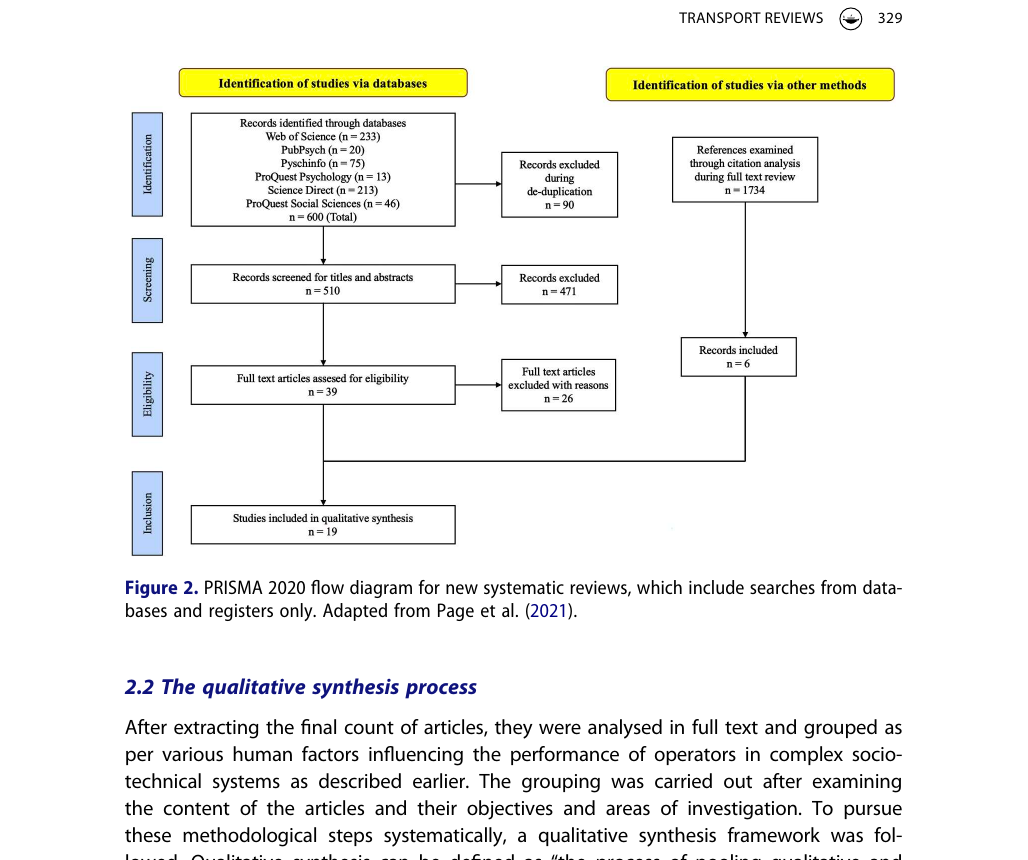
VTS itself is described as delivering three services — Information Service (INS), Navigational Assistance Service (NAS) and Traffic Organisation Service (TOS) — and is typically run 24 hours across two or three shifts of six or seven operators plus a team leader, though national regulation makes manning highly variable (Yoo & Kim, 2021) (PDF p. 5, orig. p. 325). Across the corpus, the six factors did not appear equally: by frequency of occurrence fatigue, communication and decision making each accounted for 18.2% of factor mentions and mental workload for 15.2%, with coordination and situation awareness at 9% and perception and team work at 6.1% (Figure 2 below) (PDF p. 11, orig. p. 331).
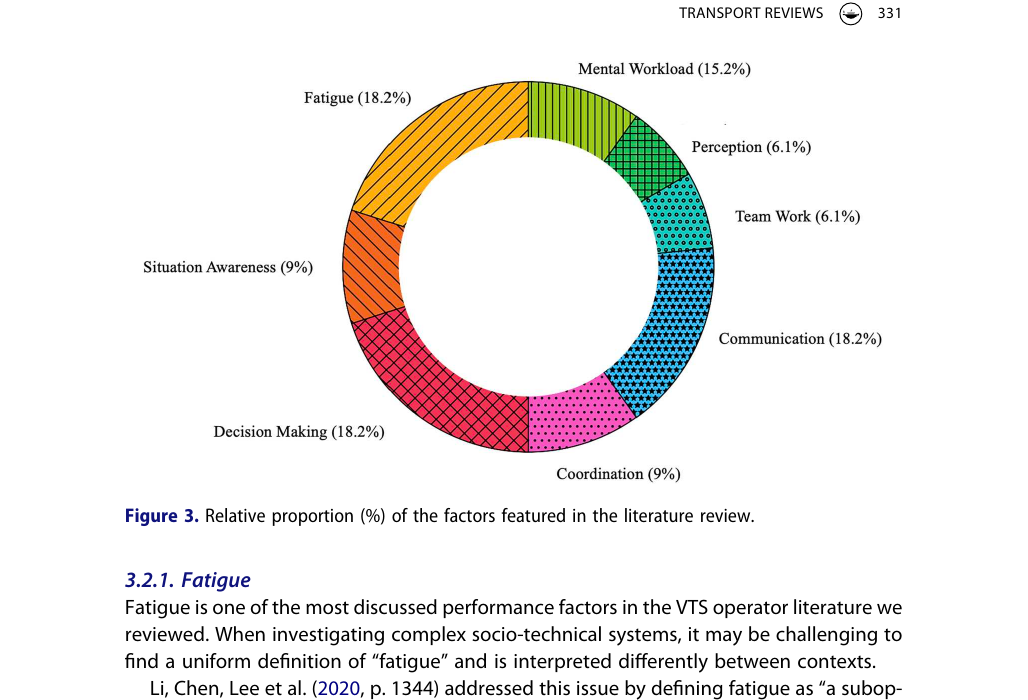
Fatigue. Fatigue is the most-discussed performance factor, with no uniform definition across the corpus. A Singapore observation study defined operator fatigue as multidimensional — physical fatigue more dominant than cognitive — and derived twelve causal factors including rest/recovery, workload, amount of information, continuous monitoring, language barriers and unnecessary alarms (Li, Chen, Xu et al., 2020) (PDF pp. 11–12, orig. pp. 331–332). A Spanish VTS field study found fatigue and workload highest on night shifts and that operators with at least eight hours' sleep reported later fatigue onset, though sleep amount did not significantly change reported workload (Crestelo Moreno et al., 2023) (PDF p. 11, orig. p. 331). Structural equation modelling of survey data ranked sleep quality the most important factor for operators' mental and physical fatigue (Yen et al., 2016) (PDF p. 12, orig. p. 332). Measurement work pointed toward unobtrusive methods: an eye-tracking "gaze-bin" machine-learning model detected fatigue with better accuracy than classical models but could not yet separate medium fatigue from alertness (Li et al., 2019) (PDF p. 12, orig. p. 332).
Mental workload. Two studies had workload as their primary focus. An early NASA-TLX survey found no workload difference across operator cohorts and no dependence on experience, age or nationality, and recommended pairing self-report with objective measures (Kum et al., 2008) (PDF pp. 12–13, orig. pp. 332–333). A later study used facial-temperature change from a thermal camera as a workload proxy, reporting more stable facial temperatures in experienced operators (Murai et al., 2015) (PDF p. 13, orig. p. 333). The number and speed of vessels emerged as the main workload drivers, prompting a proposal to replace "one size fits all" shifts with adaptive rotating shifts based on AIS traffic data (Xu et al., 2020), while easing communication demands did not reliably lower perceived workload (Aylward et al., 2020) (PDF p. 13, orig. p. 333).
Communication. Communication is the dominant social factor. A grounded-theory field study identified role ambiguity, judgement/trust/over-reliance, and closed- versus open-loop communication as the factors most relevant to operator judgement: operators often communicate indirectly, asking clarifying questions rather than issuing instructions, and lean on prior acquaintance with a vessel to gauge how much caution to apply (Costa et al., 2018) (PDF pp. 13–14, orig. pp. 333–334). An interview study modelled how operators build a mental picture from vessel size, speed, location and anomalies and choose whether to intervene, while staying cautious about appearing to interfere with the bridge team or pilot — making role ambiguity central to communication (Brodje et al., 2010) (PDF p. 14, orig. p. 334). The review treats VHF radio as the persistent primary channel for reading vessel intentions.
Decision making. Studies used varied cognitive-engineering methods. One applied Klein's (1998) recognition-primed decision model to stage operator cognition as situation awareness, situation judgement and decision, and proposed a "Vessel Traffic Routine" instructional tool that gave inexperienced operators faster, more accurate risk prediction (Song et al., 2022) (PDF pp. 14–15, orig. pp. 334–335). Two studies applied the Functional Resonance Analysis Method (FRAM): one found VTS contributes to safety by shaping preconditions for vessels and creating foresight for pilots and port services, but warned that too many inter-dependencies make the system "brittle" (Praetorius et al., 2015); the other mapped the navigation-assistance process in pilotage and stressed local knowledge, preparation and mutual trust between vessel, pilot and VTS (de Vries, 2017) (PDF p. 15, orig. p. 335).
Perception and coordination. Operators draw on only a subset of available sensors — VHF, radar, CCTV, AIS, ECDIS and meteorological data — selected by experience and expert judgement (Brodje et al., 2010) (PDF pp. 15–16, orig. pp. 335–336). The corpus reports conflicting use of AIS: some operators distrusted manually-updated AIS fields and treated it as complementary to VHF, while others used it as the primary tool for a shared traffic picture (Mansson et al., 2017; de Vries, 2017) (PDF p. 16, orig. p. 336). On coordination, operator experience was the major resource for coping with complexity, and crews deliberately pair less-experienced with experienced operators (Relling et al., 2020); Sea Traffic Management (STM) route-exchange services were evaluated positively for real-time coordination but raised concerns about added workload (Aylward et al., 2020) (PDF pp. 16–17, orig. pp. 336–337). Several studies describe the marine pilot as the central coordinating mediator, with operators minimising direct bridge-team contact until the pilot is involved — a reliance underpinned by shared geography and implicit trust (Mansson et al., 2017; de Vries, 2017) (PDF p. 17, orig. p. 337).
Identified gaps. Despite a search covering attention, vigilance and shared mental models, no included study focused on those three factors (PDF pp. 19–20, orig. pp. 339–340). The review also did not test causal links — for example whether changed workload degrades situation awareness, or fatigue degrades communication — and flags this as needing dedicated work (PDF p. 20, orig. p. 340).
Conclusion
Sharma et al. (2026) conclude that the empirical VTS human-factors literature, though small and recent, consistently casts the operator's role as area-specific information provision, traffic-fluency organisation and navigational assistance within a larger socio-technical system that also contains the pilot and the ship's bridge team. Fatigue and mental workload dominate the research attention and admit partial mitigations — regulated rest, sleep hygiene, adaptive AIS-based shifts, and objective psychophysiological measurement — while communication and coordination hinge on role ambiguity, trust, and the pilot acting as mediator. The authors argue that automation and remote pilotage will push VTS toward a more active, tactical role (Relling et al., 2022), reshaping workload and team composition, and that the field still lacks studies of attention, vigilance and shared mental models and any causal modelling between factors. The review's own limits — selection and publication bias, an English-only inclusion criterion, and a focus on individual rather than team units of analysis — bound these conclusions. The practical reading for remote-operations design is that VTS, like ATC before it, will need its information presentation, alarm handling and team structure re-examined as the role shifts from monitoring toward active traffic control.
Related
- Active Control Vs Passive Monitoring Atc — air traffic control as the supervisory-monitoring counterpart; the active-vs-passive shift the review anticipates for VTS
- Multi Ship Remote Operations Workload Sa — workload, attention and situation awareness in one-to-many shore supervision
- Cmoroc Roc Competence Framework — ROC operator staffing and competence, parallel to VTS manning and IALA training standards
- Cry Wolf Phenomenon Multiple Alarms — alarm management; "unnecessary alarms" appear here as a named fatigue cause and a target for multimodal alarm redesign
- Remote Operation Centres Mass — shore-based control of vessels, the trajectory VTS automation points toward
- Human In The Loop Automation Transparency — confidence/accuracy indication for decision-support information, a need the review raises for radar and AIS
References
Aylward, K., Johannesson, A., Weber, R., MacKinnon, S.N. and Lundh, M. (2020) 'An evaluation of low-level automation navigation functions upon vessel traffic services work practices', WMU Journal of Maritime Affairs, 19(3), pp. 313–335. doi: 10.1007/s13437-020-00206-y. To be validated.
Brödje, A., Lützhöft, M. and Dahlman, J. (2010) 'The whats, whens, whys and hows of VTS operator use of sensor information', in Proceedings of the International Conference on Human Performance at Sea (HPAS), Glasgow. University of Strathclyde, pp. 161–172. To be validated.
Cook, R.I. and Woods, D.D. (2018) 'Operating at the sharp end: The complexity of human error', in Bogner, S.M. (ed.) Human Error in Medicine. CRC Press, pp. 255–310. To be validated.
Costa, N.A., Lundh, M. and MacKinnon, S.N. (2018) 'Non-technical communication factors at the vessel traffic services', Cognition, Technology & Work, 20(1), pp. 63–72. doi: 10.1007/s10111-017-0448-9. To be validated.
Crestelo Moreno, C., Soto-López, F., Menéndez-Teleña, V., Roca-González, D., Suardíaz Muro, J., Roces, J., Paíno, C., Fernández, M. and Díaz-Secades, I. (2023) 'Fatigue as a key human factor in complex sociotechnical systems: Vessel traffic services', Frontiers in Public Health, 11, 1160971. doi: 10.3389/fpubh.2023.1160971. To be validated.
de Vries, L. (2017) 'Work as done? Understanding the practice of sociotechnical work in the maritime domain', Journal of Cognitive Engineering and Decision Making, 11(3), pp. 270–295. doi: 10.1177/1555343417707664. To be validated.
Klein, G.A. (1998) 'The recognition-primed decision model', in Sources of Power: How People Make Decisions. Cambridge, MA: MIT Press, pp. 15–30. To be validated.
Kum, S., Furusho, M. and Fuchi, M. (2008) 'Assessment of VTS operators' mental workload by using NASA Task Load Index', The Journal of Japan Institute of Navigation, 118, pp. 307–314. doi: 10.9749/jin.118.307. To be validated.
Li, F., Chen, C.H., Xu, G., Chang, D. and Khoo, L.P. (2020) 'Causal factors and symptoms of task-related human fatigue in vessel traffic service: A task-driven approach', The Journal of Navigation, 73(6), pp. 1340–1357. doi: 10.1017/S0373463320000326. To be validated.
Li, F., Chen, C.H., Xu, G. and Khoo, L.P. (2019) 'Proactive mental fatigue detection of traffic control operators using bagged trees and gaze-bin analysis', Advanced Engineering Informatics, 42, 100987. doi: 10.1016/j.aei.2019.100987. To be validated.
Mansson, J.T., Lützhöft, M. and Brooks, B. (2017) 'Joint activity in the maritime traffic system: Perceptions of ship masters, maritime pilots, tug masters, and vessel traffic service operators', The Journal of Navigation, 70(3), pp. 547–560. doi: 10.1017/S0373463316000758. To be validated.
Murai, K., Kitamura, K. and Hayashi, Y. (2015) 'Study of a port coordinator's mental workload based on facial temperature', Procedia Computer Science, 60, pp. 1668–1675. doi: 10.1016/j.procs.2015.08.277. To be validated.
Praetorius, G., Hollnagel, E. and Dahlman, J. (2015) 'Modelling vessel traffic service to understand resilience in everyday operations', Reliability Engineering & System Safety, 141, pp. 10–21. doi: 10.1016/j.ress.2015.03.020. To be validated.
Relling, T., Lützhöft, M., Hildre, H.P. and Ostnes, R. (2020) 'How vessel traffic service operators cope with complexity – only human performance absorbs human performance', Theoretical Issues in Ergonomics Science, 21(4), pp. 418–441. doi: 10.1080/1463922X.2019.1682711. To be validated.
Relling, T., Lützhöft, M., Ostnes, R. and Hildre, H.P. (2022) 'The contribution of vessel traffic services to safe coexistence between automated and conventional vessels', Maritime Policy & Management, 49(7), pp. 990–1009. doi: 10.1080/03088839.2021.1937739. To be validated.
Sharma, A., Mallam, S., MacKinnon, S.N. and Sætrevik, B. (2026) 'A systematic review of cognitive and social factors in vessel traffic services operations', Transport Reviews, 46(2), pp. 322–343. doi: 10.1080/01441647.2025.2569578. sharma2026systematic
Song, B., Itoh, H. and Kawamura, Y. (2022) 'Development of training method for vessel traffic service based on cognitive process', Cognition, Technology & Work, 24(2), pp. 1–19. doi: 10.1007/s10111-021-00684-x. To be validated.
Xu, G., Chen, C.H., Li, F. and Qiu, X. (2020) 'AIS data analytics for adaptive rotating shift in vessel traffic service', Industrial Management & Data Systems, 120(4), pp. 749–767. doi: 10.1108/IMDS-01-2019-0056. To be validated.
Yen, J.R., Wang, Y.Y., Chang, C.C. and Chang, C.Y. (2016) 'A structural equation analysis of vessel traffic controllers' fatigue factors', International Journal of Shipping and Transport Logistics, 8(4), pp. 442–455. doi: 10.1504/IJSTL.2016.077309. To be validated.
Yoo, S.L. and Kim, K.I. (2021) 'Optimal staffing for vessel traffic service operators: A case study of Yeosu VTS', Sensors, 21(23), 8004, pp. 1–17. doi: 10.3390/s21238004. To be validated.
Open Questions
- The review found no included study on attention, vigilance or shared mental models despite searching for them (PDF pp. 19–20, orig. pp. 339–340). Whether these are genuinely understudied in VTS or filtered out by the inclusion criteria and English-only constraint is unresolved, and connects to the attention/vigilance themes in Multi Ship Remote Operations Workload Sa.
- No reviewed study tested causal links between factors (e.g. workload → situation awareness, fatigue → communication). The interactions remain unmodelled.
- The role of the marine pilot as coordinating mediator is unsettled: if automation and remote pilotage remove or change the pilot, the review notes no clear account of what replaces the pilot's coordination function. This bears on ROC intervention and handover design (Cmoroc Roc Competence Framework, Remote Operation Centres Mass).
- AIS use is contradictory across the corpus — primary shared-picture tool in some centres, distrusted and merely complementary in others. What drives the difference (centre, training, traffic type, data quality) is open and bears on decision-support and confidence-indication design (Human In The Loop Automation Transparency).