Shore Control Centre Situation Awareness in the MUNIN Project
Status: emerging
Last updated: 2026-06-16
Sources: Man 2015 Desk To Field Remote Monitoring.Pdf
Tags: [shore-control-center, situation-awareness, munin, autonomous-vessels, unmanned-ships, remote-operations, alarm-management, harmony-framework, ship-sense, team-situation-awareness, human-centred-automation]
Summary
Man, Lundh, Porathe and MacKinnon (2015), working within the EU MUNIN project, study how an operator at a Shore Control Centre (SCC) builds situation awareness (SA) while remotely monitoring autonomous unmanned vessels. Five master mariners and a ship engineer ran five scenarios in a mock SCC, with think-aloud, observation, and interview data analysed by grounded theory against Endsley's three-level SA model and the "harmony" (ship-sense) framework. Moving the watchkeeper from ship's bridge to shore desk strips away physical cues and produces four SA discrepancies (D1–D4) plus an organisational fifth (Gap 5), which together break SA in two phases — failures of perception (missed or absent alarms, vision tunnelling) and failures of comprehension and projection (decayed SA, poor information support, mis-set alarm thresholds). The authors conclude that an SCC alarm and information system must be far more proactive than a ship's bridge and must not simply replicate the bridge. Within this knowledge base the paper is the foundational SA-at-distance source, sitting beside the experimental evidence in Human Factors Supervisory Control Autonomous Vessels and the workload findings in Multi Ship Remote Operations Workload Sa.
Body
Context
Man, Lundh, Porathe and MacKinnon (2015) examine the human-factor issues of remote monitoring and control of autonomous unmanned vessels in the EU MUNIN project, which envisaged an autonomous dry bulk carrier run by an automated ship controller and concurrently supervised by an operator ashore (PDF p. 2, orig. p. 2675). The method is qualitative and exploratory: five participants (four master mariners, one ship engineer) ran five scenarios in a mock SCC, and the think-aloud, observation, and interview data were coded by grounded theory in MAXQDA, framed by Endsley's SA model and the "harmony"/ship-sense framework (PDF p. 3–4, orig. p. 2676–2677). In this knowledge base it is the source on how situation awareness is built — or lost — when supervision moves from ship to shore. It underpins the SA and out-of-the-loop concerns in Human In The Loop Automation Transparency, shares the multi-vessel monitoring problem of Multi Ship Remote Operations Workload Sa, connects its alarm findings to Cry Wolf Phenomenon Multiple Alarms, and gives the human-factor backdrop to the controlled experiment in Human Factors Supervisory Control Autonomous Vessels.
Key Points
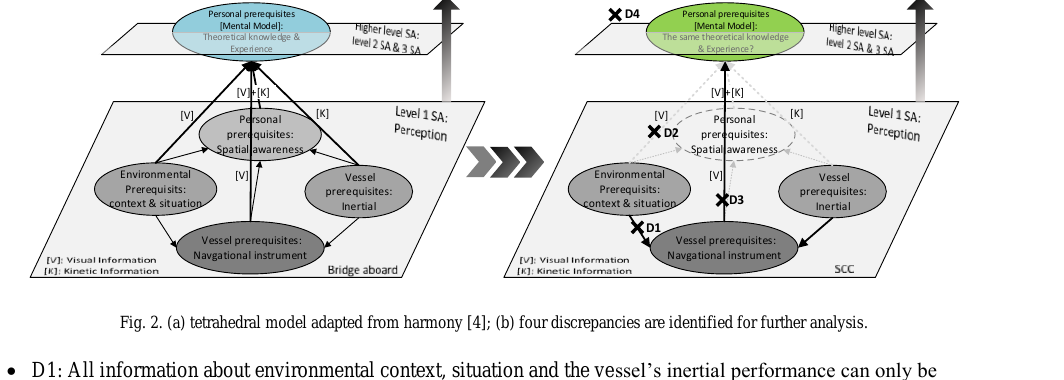
The central problem is situation awareness. Following Endsley, SA is the perception of elements (Level 1), comprehension of their meaning (Level 2), and projection of their future status (Level 3); maintaining adequate SA is the primary human-factors challenge of human-centred automation, and how an onshore operator achieves it is unknown (PDF p. 2, orig. p. 2675). The authors frame this through "harmony", derived from a ship handler's ship sense, which rests on three prerequisite groups — environmental (context and situation), vessel-specific (inertia and navigational instruments), and personal (spatial awareness, theoretical knowledge, and experience). Geographic separation removes many physical cues and so threatens both harmony and SA (PDF p. 2, orig. p. 2675).
The SCC setting concretises the one-to-many problem: each operator monitors six unmanned vessels from a workstation with six dashboards, a customised electronic chart, a conning display, and a weather chart (PDF p. 3, orig. p. 2676). Each dashboard uses colour flags — green (normal), yellow (non-critical, needs attention), and red (critical, needs immediate action) — and a modes viewer showing the vessel's control mode (autonomous, remote control, fail-to-safe, manual); when the autonomous controller cannot correct a threshold breach it escalates a flag to the operator (PDF p. 3, orig. p. 2676). A supervisor can reallocate resources and call the captain (legally responsible, final decision maker) or engineer, with ship-handling performed in a separate situation-handling room. This six-vessel assumption mirrors the MUNIN sizing recorded in Multi Ship Remote Operations Workload Sa and the ROC scoping in Remote Operation Centres Mass.
The analysis maps harmony onto Endsley's SA levels in a tetrahedral model and identifies four desk-to-field discrepancies (PDF p. 4–5, orig. p. 2677–2678). D1: all environmental and inertial information is only remotely sensed, so sensor technology must be re-examined for Level 1 SA. D2: the operator cannot feel the vessel's motion, and the static office restrains perception. D3: cues arrive only through multiple navigational instruments, forcing the operator to scan and integrate across screens. D4: the operator's seafaring experience does not transfer to the same physical and cognitive processes, so training and adaptation are needed. D3 and D4 together most threaten the higher SA levels. A fifth discrepancy and gap (Gap 5) is then identified — organisational hierarchy and regulation — which affects team SA rather than the individual's (PDF p. 5–6, orig. p. 2678–2679).
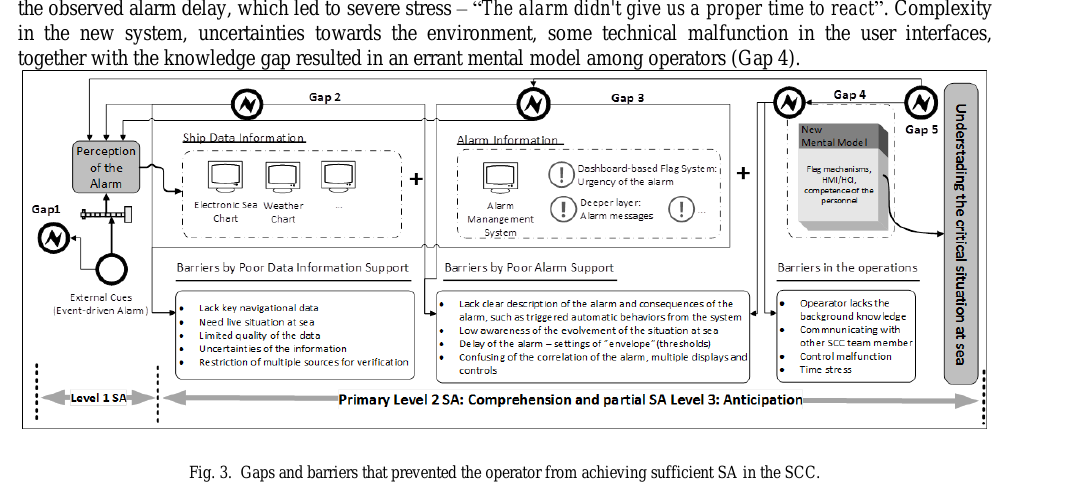
These discrepancies break SA in two phases (PDF p. 6, orig. p. 2679). In the pre-perception phase (Level 1) operators miss or never receive alarms, tunnel their vision, and are distracted by multitasking — "If there is no audio with the alarm, we probably would miss it." In the post-perception phase (Levels 2–3) SA decays because information support is poor, the operator cannot feel waves or hear the engine, has no sense of urgency, and faces alarm thresholds set for the bridge rather than the shore — "The alarm didn't give us a proper time to react." The team-SA failure is concrete: in the collision scenario the operator called the captain late out of over-confidence, leaving the captain "the team-SA chain's weakest and most vulnerable link" and producing time stress (PDF p. 6–7, orig. p. 2679–2680). The alarm and threshold problems here are the SCC counterpart of the alarm-trust failures in Cry Wolf Phenomenon Multiple Alarms.
The design implications follow from the gaps (PDF p. 7–8, orig. p. 2680–2681). The SCC alarm system must be far more proactive than an onboard system because the shore team needs more time to get "in the loop"; onboard thresholds are unsuitable for remote monitoring; alarms should convey an event's tendency rather than a static three-colour state; visual, audio, and haptic cues should be added; and — emphatically — the SCC must not mimic the bridge ("old wine in a new bottle") but be designed holistically and SA-oriented to "regain harmony onshore". This is the interface-design argument that Ecological Interface Design Fault Diagnosis Atc makes for the ATC control room.
Conclusion
Man et al. (2015) conclude that relocating the watch from bridge to shore removes the physical and experiential basis of a seafarer's situation awareness, and that an SCC therefore cannot be a transplanted bridge: its alarms must be earlier and richer, its information support must rebuild the comprehension and projection that physical cues once supplied, and its organisation must support team SA so the responsible captain is not left out of the loop. As an exploratory study with five participants in a mock centre, its findings are held as emerging, but they set the human-factors agenda that the later controlled experiment in Human Factors Supervisory Control Autonomous Vessels tests directly — most visibly on alarm timing, available time, and the difficulty of a remote takeover.
Related
- Human Factors Supervisory Control Autonomous Vessels
- Multi Ship Remote Operations Workload Sa
- Human In The Loop Automation Transparency
- Remote Operation Centres Mass
- Cry Wolf Phenomenon Multiple Alarms
- Ecological Interface Design Fault Diagnosis Atc
- Mass Roc State Of The Art
- Cognitive Social Factors Vts Operations
- Trust In Human Autonomy Teaming
References
Endsley, M.R. (1995) 'Toward a theory of situation awareness in dynamic systems', Human Factors, 37(1), pp. 32–64. doi: 10.1518/001872095779049543. To be validated
Man, Y., Lundh, M., Porathe, T. and MacKinnon, S. (2015) 'From Desk to Field — Human Factor Issues in Remote Monitoring and Controlling of Autonomous Unmanned Vessels', Procedia Manufacturing, 3, pp. 2674–2681. doi: 10.1016/j.promfg.2015.07.635. man2015deskfield
Open Questions
- The study rests on five participants in a mock SCC; the SA discrepancies and design implications need confirmation with larger samples and a working centre before promotion to established.
- "Harmony" / ship sense is taken from the maritime literature (Man et al.'s ref [4]) and is not held in RAW; the primary ship-sense source should be ingested to ground the framework — flagged To be validated.
- The paper argues alarms should convey "tendency" rather than a static state but does not specify how; how a proactive, tendency-based SCC alarm scheme would be designed and validated links to Cry Wolf Phenomenon Multiple Alarms and Ecological Interface Design Fault Diagnosis Atc.