KONECT: A Method for Designing Safety-Critical Monitoring Interfaces
Status: emerging
Last updated: 2026-06-16
Sources: Saager 2022 Konect Hmi Design Method.Pdf
Tags: [interface-design, human-machine-interface, monitoring, safety-critical-systems, information-visualization, control-centre-design, design-method, ecological-interface-design, hierarchical-task-analysis, remote-operations]
Summary
Saager, Osterloh and Brück (2022), at DLR, describe KONECT, an engineering-driven method for systematically deriving information visualizations for monitoring tasks in safety-critical systems so that the resulting human-machine interface minimises an operator's reaction time to critical states. The method runs in four steps — information determination, an "idea box", glyph sketching, and design composition — and yields a quantitative "KONECT value" that estimates perceptual accuracy and reaction time and lets designers compare interface alternatives early. The paper is a position/method paper: it reports no new experiment, but it sets out the method's current tool support (a JavaFX application that stops at the idea box and the metric) and a set of planned extensions, including multimodal output, adaptive interfaces, and a new web tool with in-tool task analysis and a glyph/composition editor. Its motivation — remote operators monitoring autonomous vehicles in mission control centres — places it squarely in this knowledge base as a control-centre interface-design method, beside the ecological-interface-design approach in Ecological Interface Design Fault Diagnosis Atc.
Body
Context
Saager, Osterloh and Brück (2022) address the rising monitoring demand created by automation and AI across all transport modes: highly automated and autonomous vehicles (cars, vessels, air-taxis) require mission control centres where remote operators monitor each vehicle to detect faults or stuck systems, and the volume of information they must process keeps growing (PDF p. 1, orig. p. 1). Because overlooking or misinterpreting a safety-critical state has serious consequences, interfaces must be designed so that state changes are noticed as fast as possible. The paper studies KONECT — a method originated by M.-C. Harre — and proposes extensions and a new tool implementation rather than evaluating it empirically (PDF p. 2, orig. p. 2). In this knowledge base it is the interface-design-method source for the control-centre and display-systems focus area: it complements the ecological-interface-design account in Ecological Interface Design Fault Diagnosis Atc, gives a constructive design counterpart to the SCC alarm and information-support gaps identified in Shore Control Centre Situation Awareness Munin, and targets the same remote-monitoring problem as Remote Operation Centres Mass and Multi Ship Remote Operations Workload Sa.
Key Points
KONECT is an engineering-driven method that lets designers systematically derive information visualizations for monitoring tasks, producing an HMI with the shortest possible operator response time to critical states; in its current form it is limited to the fast recognition of quantitative and qualitative values (PDF p. 1 & 3, orig. p. 1 & 3). It builds on and extends two established approaches that, alone, do not yield systematic visualizations: Hierarchical Task Analysis (HTA), which captures the conscious and routine tasks, and Ecological Interface Design (EID) with its work-domain abstraction hierarchy for rare or unforeseen situations — combined with perception research to bridge from task to display (PDF p. 2–3, orig. p. 2–3). The EID lineage ties the method directly to Ecological Interface Design Fault Diagnosis Atc.
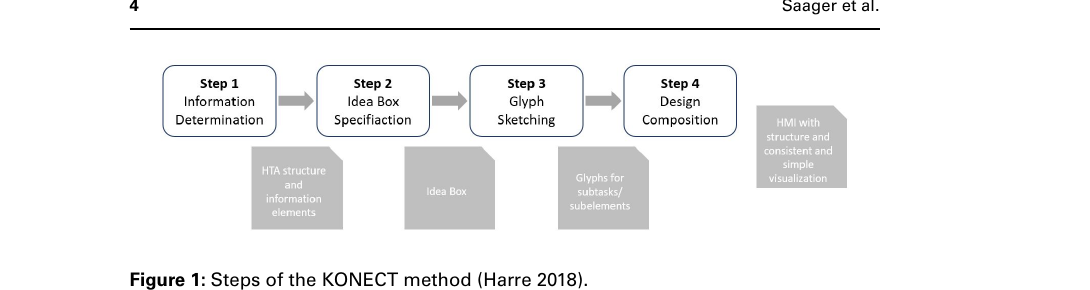
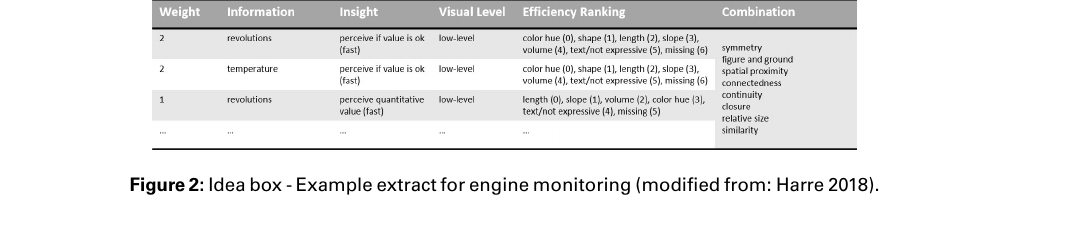
The method has four steps (PDF p. 3–4, orig. p. 3–4). Step 1, information determination, derives the important information from the target system through research, interviews, or HTA/EID. Step 2, the idea box, is the core: each information item is entered in descending order of importance, and for each the designer determines the insight the operator needs (e.g. "is the temperature still in range?") from a predefined list grounded in perception psychology; each insight maps to a visual-efficiency ranking of visual attributes (colour, shape, length, …), a time factor (whether recognition is pre-attentive), and a visual level (low-level, where one attribute suffices, versus high-level, requiring comparison of several). Step 3, glyph sketching, combines each information item with its proposed visual elements — a bar whose length encodes a value and whose colour flags a critical range — assembled using design laws such as symmetry and proximity. Step 4, design composition, checks the assembled design against three of Harre's rules: consistency (similar information uses similar representations), simplicity in shapes, and simplicity in colours.
From the chosen attributes and any guideline violations the method computes a KONECT value K (range 0–1) that estimates relative perceptual accuracy and reaction time, revealing design shortcomings and letting alternatives be compared in early design phases (PDF p. 4, orig. p. 4). This quantitative, comparison-of-alternatives stance distinguishes KONECT from the qualitative interface critique elsewhere in the corpus.
The paper is candid about the gap between method and tooling. A basic JavaFX tool supports completing the idea box and calculating K, but effectively ends there: glyph sketching (Step 3) and design composition (Step 4) must be done manually, with no tool support and a "tool break" between analysis and design (PDF p. 4–7, orig. p. 4–7). The proposed extensions are therefore both conceptual and practical: making the method multimodal (sound, haptics) to reduce visual load during multitasking, adding interaction knowledge, and investigating adaptive HMIs that respond to operator under- or overload; and building a new web-based tool that performs HTA in-tool (auto-pre-filling the idea box), adds a card-based drag-and-drop view for weighting and sorting information, and provides a glyph-sketching and design-composition editor with automatic design checks and traceability from requirements to design decisions (PDF p. 5–7, orig. p. 5–7). Because these are stated as planned work, they are recorded here as proposals rather than results.
Conclusion
Saager et al. (2022) present KONECT as a systematic, perception-grounded route from monitoring tasks to fast-to-read safety-critical interfaces, and report that work on a new web-based tool — already connected to a task editor — has begun, with three priorities ahead: exploring interaction elements and linking information to interface elements, further software implementation, and building the glyph/composition editor (PDF p. 7, orig. p. 7). As a method-and-roadmap paper without its own evaluation, it is held as emerging, and its claims about reaction-time benefit rest on the underlying Harre work rather than on new evidence here. Its constructive value to this knowledge base is to offer a concrete design procedure for the very SCC information- and alarm-support gaps that Shore Control Centre Situation Awareness Munin diagnoses, and to extend the ecological-interface-design tradition of Ecological Interface Design Fault Diagnosis Atc toward a repeatable, measurable workflow.
Related
- Ecological Interface Design Fault Diagnosis Atc
- Shore Control Centre Situation Awareness Munin
- Remote Operation Centres Mass
- Multi Ship Remote Operations Workload Sa
- Human In The Loop Automation Transparency
- Cry Wolf Phenomenon Multiple Alarms
References
Harre, M.-C. (2019) A Systematic Approach to the Design of Information Visualizations for Monitoring Tasks in Safety-Critical Systems. Doctoral dissertation, University of Oldenburg. To be validated
Harre, M.-C. and Feuerstack, S. (2018) cited in Saager et al. (2022) for the KONECT value; original not held in RAW. To be validated
Saager, M., Osterloh, J.-P. and Brück, Y. (2022) 'KONECT: Implementation and Extension of a Method for the Development of Safety-Critical Human-Machine Interaction Interfaces', Human Factors in Software and Systems Engineering, 61, pp. 1–8. doi: 10.54941/ahfe1002515. saager2022konect
Open Questions
- KONECT's reaction-time benefit is asserted from the originating Harre work, not demonstrated in this paper; the empirical basis for the KONECT value K as a predictor of operator reaction time should be traced by ingesting Harre (2019) / Harre & Feuerstack (2018) — flagged To be validated.
- Most of the paper describes planned extensions (multimodal output, adaptive HMIs, the web tool and editors); which were actually implemented is unresolved and would need a follow-up source.
- KONECT is currently limited to recognising quantitative and qualitative values; whether it can derive visualizations for the comprehension- and projection-level information that Shore Control Centre Situation Awareness Munin shows is hardest to support remotely is open.