Human Factors in Supervisory Control of Remotely Operated and Autonomous Vessels
Status: emerging
Last updated: 2026-06-16
Sources: 1 S2.0 S0029801824005948 Main.Pdf
Tags: [remote-supervisory-control, autonomous-ships, mass, maritime-human-factors, handover-takeover, decision-support-system, situational-awareness, vigilance-decrement, multivessel-supervision, shore-control-centre, simulator-experiment, risk-influencing-factors]
Summary
Veitch et al. (2024) report a randomized factorial simulator experiment (n = 32) on how a human operator supervises a remotely operated, highly automated passenger ferry, testing five factors: Skillset (gamers vs navigators), Monitoring Time (5 vs 30 min), Number of Vessels (1 vs 3), Available Time (20 vs 60 s), and a Decision Support System (DSS, available vs not). Each participant performed a handover (automation hands control over) and a takeover (operator takes control). Neither gamers nor navigators were superior; longer monitoring raised boredom but barely touched performance; performance fell when supervising three vessels, under short available time, and without a DSS. The DSS had the single largest effect on handovers yet did nothing for takeovers, and a 5-minute/20-second combination produced collisions every time. Within this knowledge base the study supplies controlled empirical evidence for the one-to-many and out-of-the-loop concerns running through Multi Ship Remote Operations Workload Sa and Human In The Loop Automation Transparency, and it operationalises the handover/takeover intervention as a unit of analysis for ROC design.
Body
Context
Veitch, Alsos, Cheng, Senderud and Utne (2024) ask which factors influence human supervisory control of highly automated vessels, framing the question around interventions — the moments when control transfers between the automation and the operator (PDF p. 2, orig. p. 2). The method is a controlled simulator experiment: a Unity digital twin of the autonomous urban ferry milliAmpere2, built on the open-source Gemini platform and hosted at the NTNU Shore Control Lab, recreating a 100 m canal crossing modelled on the 2022 Trondheim public trials (PDF p. 2 & 4, orig. p. 2 & 4). The paper contributes a tested five-factor model, a reusable experimental method, and results on the operator's role. In this knowledge base it gives experimental backing to the cross-domain workload and SA claims compiled in Multi Ship Remote Operations Workload Sa, the out-of-the-loop and transparency concerns in Human In The Loop Automation Transparency and Out Of The Loop Performance Problem, and the operator-to-vessel ratio evidence in Massterly Chief To Shore Operator Ratio; it shares the milliAmpere2/Shore Control Lab setting with Remote Operation Centres Mass.
Key Points
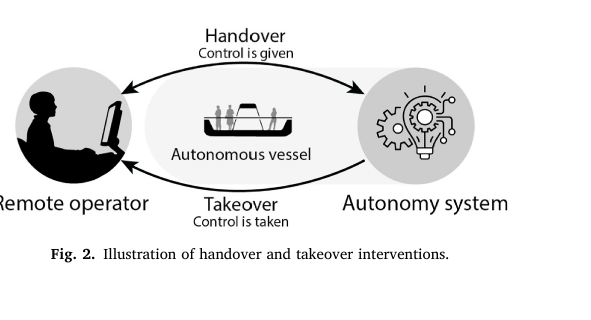
The study crosses five factors, each chosen to fill a specific gap: A Skillset (16 gamers vs 16 navigators), B Monitoring Time (5 vs 30 min passive monitoring), C Number of Vessels (1 vs 3 ferries), D Available Time (a 20 vs 60 s critical window), and E DSS (available vs unavailable) (PDF p. 2–3, orig. p. 2–3). Two intervention types are defined and treated as intended system functionality rather than failures: a handover, where the automation detects a critical event and hands control to the operator, and a takeover, where the operator detects the event and takes control (PDF p. 2–4, orig. p. 2–4). The design is a full 2⁵ = 32-treatment factorial run as a handover scenario then a takeover scenario; because Skillset cannot be randomised within a person it is handled as a split-plot in four blocks of eight and analysed with REML ANOVA at an exploratory threshold of α = 0.10 (PDF p. 6 & 8, orig. p. 6 & 8). Performance is measured by handover track score and handover time for the handover, and by collision outcome (avoided / near miss / collision) for the takeover (PDF p. 6–7 & 9, orig. p. 6–7 & 9).
On boredom and vigilance, only Monitoring Time mattered: operators were bored after 30 minutes but not after 5, a pure function of time-on-watch rather than of any other factor (PDF p. 9–10, orig. p. 9–10). This is the vigilance decrement that underlies the passive-monitoring problem in Active Control Vs Passive Monitoring Atc and Automation Complacency And Bias, but here it translated into only minor performance effects.
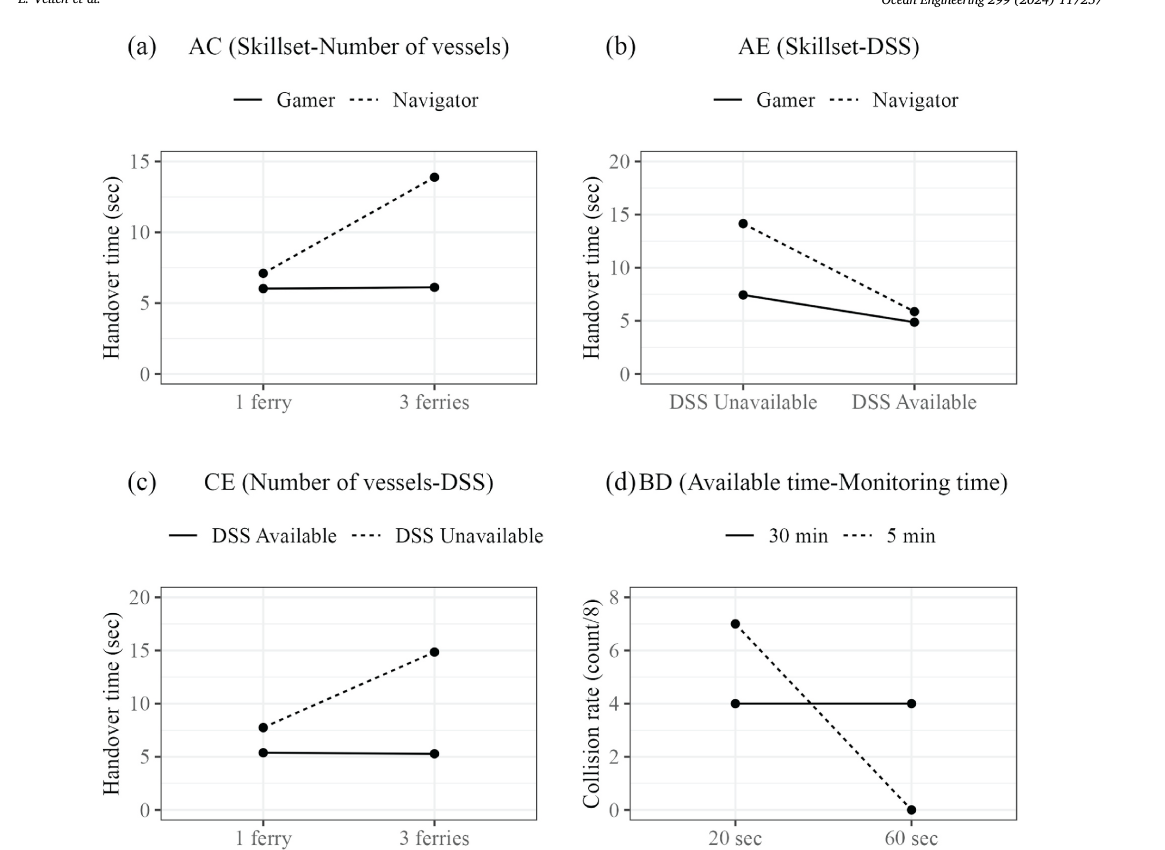
Skillset produced small main effects — gamers' handover track scores were about 8 % higher (P = 0.10) — but neither group excelled overall, and the more telling results were interactions (PDF p. 13, orig. p. 13). Gamers handed over faster than navigators when supervising three vessels (Skillset × Number of Vessels, ~7 s, P = 0.03) and when no DSS was available (Skillset × DSS, ~6 s, P = 0.01); the authors read gamers as "trigger happy" (quick but not better) and navigators as "level-headed" (slower but more deliberate), consistent with handover time and track score being only weakly related (Kendall's τ = −0.53) (PDF p. 12–13, orig. p. 12–13). The practical implication is that a future remote operator needs a hybrid skillset rather than either profile alone, which connects to the competence questions in Seafarer Skills And Competence For Mass and Cmoroc Roc Competence Framework.
Three factors degraded performance. Supervising three vessels instead of one cut handover track score by about 10 % (P = 0.06) and added roughly 3 s to handover time (P = 0.01), which the authors interpret through Bainbridge's "ironies of automation" and which corroborates the one-to-many evidence in Multi Ship Remote Operations Workload Sa and Massterly Chief To Shore Operator Ratio (PDF p. 9–10, orig. p. 9–10). The DSS had the largest effect of any factor on the handover (track score P < 0.0001; time P = 0.0002), and a Number-of-Vessels × DSS interaction showed it almost entirely cancelled the multivessel penalty — without a DSS, three-ferry handover time tripled (5→15 s) versus only 5→8 s for one ferry (P = 0.0108) (PDF p. 10, orig. p. 10). Available Time governed the takeover: collisions fell sharply from the 20 s to the 60 s window (P = 0.0009), so the effective minimum response time sat nearer 60 s (PDF p. 9 & 13, orig. p. 9 & 13).
Two results carry the strongest design messages. First, the DSS did not help takeovers at all: takeover success depended on the operator's own situation awareness, and the DSS may even have distracted during the cognitively demanding takeover — aligning with Endsley's guidance to automate routine tasks rather than higher-level cognition (PDF p. 10, orig. p. 10). Second, a Monitoring Time × Available Time interaction revealed cognitive tunneling: after 5 minutes of monitoring a 20 s window produced collisions 100 % of the time while a 60 s window avoided them 100 % of the time, whereas after 30 minutes both windows gave 50 % collisions (P = 0.009) (PDF p. 12, orig. p. 12). The dire short-monitoring/short-window case is read as attentional narrowing under sudden demand, echoing the out-of-the-loop decrement in Out Of The Loop Performance Problem.
Conclusion
Veitch et al. (2024) conclude that neither the gamer nor the navigator skillset is sufficient on its own and that Number of Vessels, Available Time, and DSS are the factors warranting design and risk-management attention, feeding directly into Risk-Influencing Factors and concrete safety requirements such as a minimum guaranteed time for takeover and handover (PDF p. 13–14, orig. p. 13–14). The DSS finding is pointed: decision support that rescues a routine, multivessel handover does nothing for a time-critical takeover that hinges on the operator's own awareness, which sharpens the transparency-versus-automation tension examined in Human In The Loop Automation Transparency and Ecological Interface Design Fault Diagnosis Atc. The authors flag the study as a factor-screening exercise — no repetitions, a constrained urban-canal envelope without radar/ECDIS/COLREGs, and simulation rather than field operation — so the results are held as emerging pending real-world verification, though the open dataset and open-source simulator make them reproducible.
Related
- Multi Ship Remote Operations Workload Sa
- Human In The Loop Automation Transparency
- Out Of The Loop Performance Problem
- Massterly Chief To Shore Operator Ratio
- Remote Operation Centres Mass
- Shore Control Centre Situation Awareness Munin
- Seafarer Skills And Competence For Mass
- Trust In Human Autonomy Teaming
- Ship Collision Avoidance Human Machine
References
Veitch, E., Alsos, O.A., Cheng, T., Senderud, K. and Utne, I.B. (2024) 'Human factor influences on supervisory control of remotely operated and autonomous vessels', Ocean Engineering, 299, art. 117257. doi: 10.1016/j.oceaneng.2024.117257. veitch2024humanfactors
Open Questions
- The design is a factor screen with no repetitions and an exploratory α = 0.10, so the effect sizes (e.g. the 8 % skillset gap) are indicative rather than confirmed; replication with repetition is needed before promotion to established.
- The DSS helped handovers but not takeovers; what form of decision support — if any — actually aids a time-critical takeover that depends on the operator's own SA is unresolved and connects to the transparency work in Human In The Loop Automation Transparency.
- The "hybrid skillset" the authors call for is asserted, not specified; which gamer-like and navigator-like competences a future remote operator needs, and how to train them, links to Seafarer Skills And Competence For Mass and Cmoroc Roc Competence Framework.