Automation Complacency and Bias
Status: emerging
Last updated: 2026-06-13
Sources: Parasuraman Manzey 2010 Complacency Automation Bias.Pdf
Tags: [automation, supervisory-control, complacency, automation-bias, attention, monitoring, trust, situation-awareness, omission-error, commission-error, levels-of-automation, remote-operations]
Summary
Parasuraman and Manzey (2010) review the empirical literature on two human performance costs of automation — automation complacency and automation bias — and argue that, although historically studied separately, both rest on a common attentional mechanism. Complacency is poorer monitoring and slower detection of automation failures that appears when manual tasks compete with a highly reliable automated task for the operator's attention. Automation bias is the tendency to follow automated advice uncritically, producing omission errors (missing events the automation does not flag) and commission errors (acting on incorrect automated advice against contradictory information). Both occur in naive and expert operators, resist simple practice and training as countermeasures, and stem from an automation-induced reallocation of attention away from raw information sources. The authors integrate these findings into a single model in which personal, situational, and automation-related factors drive a "complacency potential" that biases attention, degrades situation awareness, and surfaces as error only when the automation fails — modulated by positive ("learned carelessness") and negative (failure-driven) feedback loops.
Body
Context
Parasuraman and Manzey (2010) synthesise roughly three decades of human-factors research on complacency and automation bias across aviation, process control, and health care, and propose an integrated theoretical model and an attentional account that unifies the two literatures (PDF p. 1, orig. p. 381). The review sits at the centre of this knowledge base's automation theme: remote operation centres are supervisory-control settings in which a small number of operators monitor highly reliable autonomy and must detect and recover its failures — exactly the conditions the paper identifies as complacency-inducing. It extends Parasuraman and Riley's (1997) use/misuse/disuse/abuse taxonomy (Use Misuse Disuse Abuse Of Automation), where complacency and automation bias appear under "misuse" (overreliance), into a mechanistic, attention-based model. It connects to the trust and transparency work in Trust In Human Autonomy Teaming and Human In The Loop Automation Transparency, to the monitoring-failure findings in Active Control Vs Passive Monitoring Atc (Metzger & Parasuraman) and Cry Wolf Phenomenon Multiple Alarms, and — through its proposal to measure attention via eye tracking — to the gaze-as-attention work held in the eye-tracking knowledge base (see pupil-dilation-cognitive-load).
Key Points
Complacency: definition and evidence. There is no single agreed definition, but a common core holds: complacency involves operator monitoring of an automated system at a frequency lower than would be optimal, producing substandard detection of malfunctions (PDF pp. 2–3, orig. pp. 382–383). The Aviation Safety Reporting System defines it as "self-satisfaction that may result in nonvigilance based on an unjustified assumption of satisfactory system state," and it has been named a contributing factor in aviation and maritime accidents — including over-reliance on automatic radar plotting aids (PDF pp. 2–3, orig. pp. 382–383). Crucially, automation complacency is not mere inattention: it reflects an active reallocation of attention away from the automated task toward competing manual tasks, and it emerges reliably only under multiple-task load, not in single-task monitoring (PDF pp. 4–5, orig. pp. 384–385).
What drives and does not fix complacency. Complacency is strongest when automation reliability is high and constant; consistent, invariant performance breeds reduced monitoring, whereas variable-reliability automation sustains attention (PDF pp. 4–6, orig. pp. 384–386). It appears in both naive participants and domain experts and cannot be eliminated by simple practice, indicating it is a structural feature of attention allocation under trust rather than a skill deficit (PDF p. 1, orig. p. 381; PDF pp. 5–6, orig. pp. 385–386).
Automation bias: omission and commission errors. Automation bias is the use of automated advice as a heuristic replacement for vigilant information seeking. It produces two error types: omission errors, where operators fail to respond to events that the automation does not annunciate, and commission errors, where operators follow an automated recommendation even when other available information contradicts it (PDF pp. 11–14, orig. pp. 391–394). Simulator studies of pilots show high omission and commission rates when decision aids are imperfect — in one case roughly two-thirds of participants committed a commission error by following wrong advice without cross-checking, and physicians show comparable effects with clinical decision aids (PDF pp. 13–14, orig. pp. 393–394). Like complacency, automation bias occurs in naive and expert users, is not prevented by training or explicit instructions, and affects both individuals and teams — contributing factors include treating the aid as another team member and the resulting diffusion of responsibility and reduced felt accountability (PDF pp. 12–14, orig. pp. 392–394).
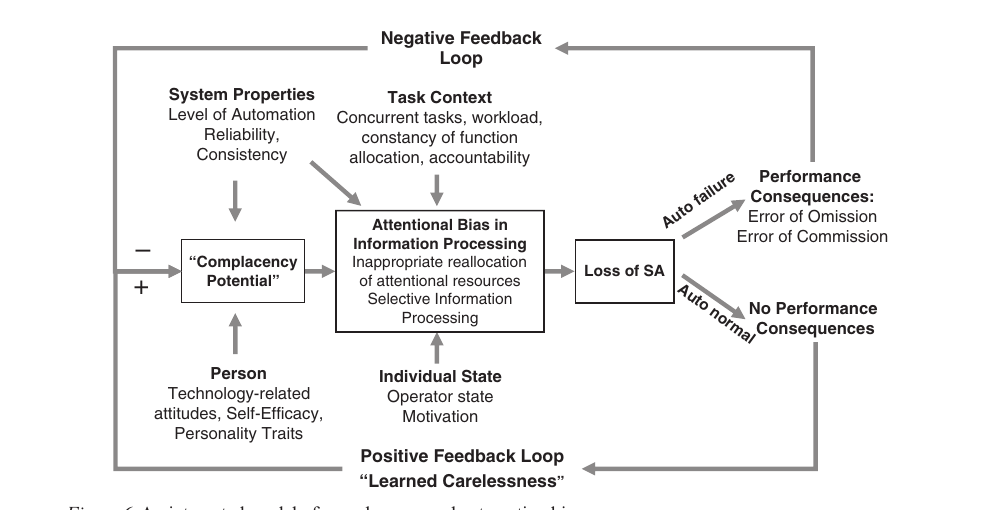
The attentional link. The paper's central argument is that complacency and automation bias are different manifestations of one underlying phenomenon: an automation-induced withdrawal or reallocation of attentional resources caused by overtrust in the system. This is a "heuristic use of automation" (Mosier & Skitka, 1996) that produces a loss of situation awareness with no visible consequence while the automation works, but directly causes omission or commission errors the moment it fails (PDF pp. 23–24, orig. pp. 403–404).
The integrated model. Figure 6 organises these factors. System properties (level of automation, reliability, consistency), person variables (technology-related attitudes, self-efficacy, personality), and task context (concurrent tasks, workload, constancy of function allocation, accountability) jointly set a "complacency potential." When task load is high, that potential expresses as an attentional bias in information processing — inappropriate reallocation of attention and selective processing — which yields a loss of situation awareness and, on automation failure, omission and commission errors (PDF pp. 23–24, orig. pp. 403–404). Two feedback loops make the process dynamic: a positive loop, in which the usual absence of failure consequences breeds "learned carelessness" and raises complacency potential over time, and a negative loop, in which experiencing an automation failure sharply reduces trust and complacency — paralleling Lee and See's (2004) trust-and-reliance model (PDF p. 24, orig. p. 404).
Measurement and mitigation. Because the effects are attentional, the authors argue that operational definitions of complacency and automation bias should rest on behavioural indicators of attention allocation — directly via eye-tracking and information-sampling measures, or indirectly via secondary-task methods — and that, following Moray (2003), an observed attention shift counts as complacency only when compared against a normative model of optimal attention allocation for that system (PDF p. 24, orig. p. 404). Proposed countermeasures include designing for variable rather than constant reliability, raising perceived accountability, using flexible or adaptive function allocation, giving operators direct experience of automation failures, and aiding information analysis rather than only the final decision (PDF pp. 24–26, orig. pp. 404–406).
Conclusion
Parasuraman and Manzey (2010) conclude that automation complacency and automation bias, long treated as separate hazards, are better understood as two expressions of a single attention-based process driven by overtrust in reliable automation. Their integrated model frames the operator's error not as carelessness or poor decision making in isolation but as the predictable consequence of how attention is reallocated when a trusted system rarely fails — with the danger concealed until the system does fail. The practical implication for supervisory control, and for remote operation centres in particular, is that complacency and bias cannot be trained away; they must be designed against, through reliability profiles, function allocation, accountability structures, and attention-aware measurement that can detect the loss of situation awareness before a failure exposes it.
Related
- Use Misuse Disuse Abuse Of Automation
- Trust In Human Autonomy Teaming
- Human In The Loop Automation Transparency
- Active Control Vs Passive Monitoring Atc
- Cry Wolf Phenomenon Multiple Alarms
References
Lee, J. D. & See, K. A. (2004) 'Trust in automation: designing for appropriate reliance', Human Factors, 46(1), pp. 50–80. doi: 10.1518/hfes.46.1.50.30392. To be validated.
Manzey, D. & Bahner, J. E. (2005) 'Vom Vertrauen in Automation zur Automation Complacency', in Berliner Werkstatt Mensch-Maschine-Systeme. To be validated.
Moray, N. (2003) 'Monitoring, complacency, scepticism and eutactic behaviour', International Journal of Industrial Ergonomics, 31(3), pp. 175–178. doi: 10.1016/S0169-8141(02)00194-4. To be validated.
Mosier, K. L. & Skitka, L. J. (1996) 'Human decision makers and automated decision aids: made for each other?', in Parasuraman, R. & Mouloua, M. (eds.) Automation and Human Performance: Theory and Applications. Mahwah, NJ: Erlbaum, pp. 201–220. To be validated.
Parasuraman, R. & Manzey, D. H. (2010) 'Complacency and bias in human use of automation: an attentional integration', Human Factors, 52(3), pp. 381–410. doi: 10.1177/0018720810376055. parasuraman2010complacency
Parasuraman, R. & Riley, V. (1997) 'Humans and automation: use, misuse, disuse, abuse', Human Factors, 39(2), pp. 230–253. doi: 10.1518/001872097778543886. parasuraman1997humans
Open Questions
- The model calls for a normative "optimal attention allocation" baseline against which to judge whether an attention shift is complacency (Moray, 2003). Defining such baselines for ROC supervisory tasks (one operator, many vessels) is unsolved and connects to the dwell-allocation models held in the eye-tracking KB (see expected-value-model-of-visual-scanning).
- The "learned carelessness" positive feedback loop predicts complacency potential rises over months of incident-free operation. Whether this is observable in real ROC operators, and whether negative-feedback events (drills, injected failures) reset it, is untested in the maritime ROC context.
- The paper proposes eye-tracking as a direct operational measure of complacency. Whether gaze metrics can flag attentional withdrawal in real time well enough to drive an intervention is an open design question linking this KB to the eye-tracking corpus.