En Route ATM Capacity Management
Status: emerging
Last updated: 2026-06-13
Sources: Eurocontrol Prc Technical Note En Route Capacity 11122020.Pdf
Tags: [air-traffic-control, air-traffic-management, en-route-capacity, ANSP, ACC, ATFM-delay, sector-hours, atco-productivity, capacity-planning, controller-workload, eurocontrol, remote-operations]
Summary
The EUROCONTROL Performance Review Commission (2020) technical note examines how en-route air traffic management (ATM) capacity is set, deployed, and planned across ten of Europe's most-constraining Area Control Centres (ACCs). It separates three notions of capacity: declared capacity (the number of aircraft per hour a sector can safely handle, fixed by airspace structure, equipment, and controller staffing), deployed capacity (what is actually made available on the day, often reduced by weather, military activity, equipment, or staffing), and planned capacity (future capacity committed in the Network Operations Plan). The note's central operational argument is that controller (ATCO) staffing — not physical airspace limits — is the binding constraint on en-route capacity, and that several ANSPs aggravate delays by operating "collapsed" sectors and by reducing deployed sector hours rather than opening elementary sectors to meet demand. It also examines the economic indicator ATCO-hour productivity and how it interacts with operational performance, and ties its findings to standing Provisional Council recommendations.
Body
Context
This source is an institutional performance-review document rather than a research paper: the EUROCONTROL Performance Review Commission (PRC), supported by the Performance Review Unit (PRU), reviews capacity management at ten ACCs (seven ANSPs) using Network Manager data to February 2020, and reports findings against expectations set by ICAO and airspace users (PDF pp. 7–8, orig. pp. 6–7). Within this knowledge base it is the macro, network-management view of air traffic control — the ATC domain named in the KB's scope — complementing the micro, single-controller human-factors articles Active Control Vs Passive Monitoring Atc (where keeping separation authority with the controller is shown to aid conflict detection) and Ecological Interface Design Fault Diagnosis Atc. Its through-line for supervisory control is that the human operator's workload sets the system's throughput ceiling, which connects the economics of staffing to the workload and attention themes in Multi Ship Remote Operations Workload Sa and Automation Complacency And Bias.
Key Points
Three types of capacity. An ANSP determines that an elementary sector can normally accommodate a given number of aircraft per hour — the declared capacity — on the basis of airspace structure, technical equipment, and ATCO staffing and expertise (PDF p. 8, orig. p. 7). On any given day the deployed capacity may be lower, reduced by external factors (adverse weather), sovereign factors (military activity), or internal ANSP factors (equipment serviceability or staffing); deploying less than declared capacity only becomes a problem when traffic demand exceeds the deployed level (PDF p. 8, orig. p. 7). Planned capacity is the future capacity each ANSP commits in the Network Operations Plan (NOP), benchmarked against the Reference Capacity Profile (PDF pp. 15–16, orig. pp. 14–15). The note illustrates declared/deployed capacity with a "liquid in a beaker" metaphor: declared capacity is neither a minimum nor a maximum, and capacity impediments reduce the traffic that fits within it (PDF p. 9, orig. p. 8).
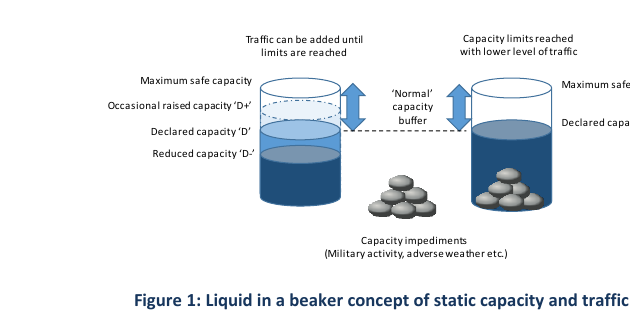
Elementary vs collapsed sectors. ANSPs group elementary sectors into larger collapsed sectors for economic reasons: opening fewer sectors needs fewer ATCOs on position, which can free controllers for peak periods. But a collapsed sector has less declared capacity than its constituent elementary sectors opened simultaneously — the note's worked example shows two open sectors accommodating up to 60 aircraft (48 under military activity) versus 45 (36) for one collapsed sector, a 25% capacity reduction attributable purely to not deploying staff to open both (PDF pp. 8–9, orig. pp. 7–8).
ATFM delay attribution and the staffing diagnosis. The PRC reviews how Air Traffic Flow Management (ATFM) delays are attributed by cause (weather, airspace management, ATC staffing, ATC equipment, special activity). Its central finding is that ATC staffing is either the cause of, or a significant contributory factor in, the majority of ATFM delays, and that high proportions of delay attributed to "adverse weather" in collapsed sectors suggest ANSPs may be aggravating weather impacts rather than mitigating them — because the constraint actually originates in operating a collapsed sector instead of opening two sectors (PDF pp. 16–17, orig. pp. 15–16). The note argues that misattributing delays to declared-capacity shortfalls implies a need for infrastructure or equipment investment, when the real causes are staffing or military activity and the latent capacity already exists and could be deployed at no additional cost (PDF p. 16, orig. p. 15).
Sector hours. Deployed sector hours (sectors open × hours open, aggregated per ACC) measure how much capacity is actually made available over time. The PRC was "surprised" that several constraining ANSPs reduced deployed sector hours year on year while traffic grew — operating more often with self-imposed, staffing-driven capacity constraints — which it does not consider consistent with meeting existing or future demand (PDF pp. 13, 18, orig. pp. 12, 17). It notes that sector hours can be managed against known traffic patterns through rostering, and that reducing non-operational tasks could free ATCO duty-time for controlling traffic (PDF p. 13, orig. p. 12).
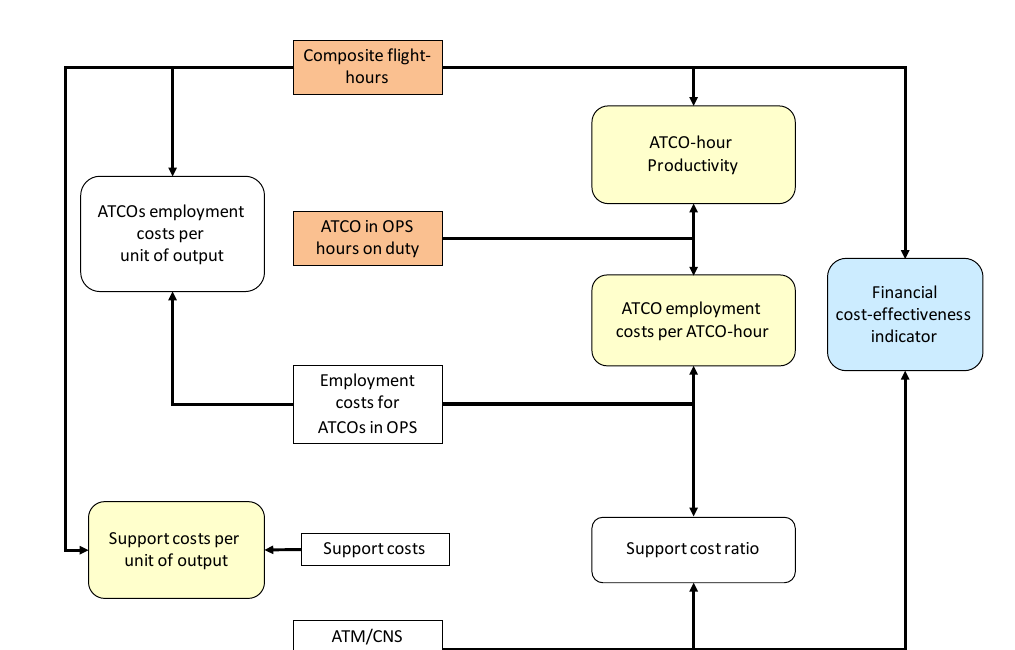
ATCO-hour productivity. The note examines the economic indicator ATCO-hour productivity — composite flight-hours divided by ATCO-hours on duty — within the ACE cost-effectiveness framework, where higher productivity improves an ANSP's financial cost-effectiveness (PDF pp. 14–15, orig. pp. 13–14). It asks whether the relationship between this economic metric and operational performance is causation or correlation: in 2018 ATFM delays rose in all ten ACCs, yet nine of ten increased ATCO-hour productivity, and two (Karlsruhe UAC, Marseille ACC) raised productivity while reducing sector hours (PDF pp. 19, orig. p. 18). The implication is that productivity gains achieved by deploying fewer sector hours can coincide with worse operational (delay) performance.
Findings and recommendations. The PRC links its findings to ten standing Provisional Council recommendations (PC 41–PC 51, 2014–2019), including: provide capacity to meet demand rather than regulating demand down to reduced capacity; develop accurate, consistent, network-centric ATFM delay attribution; implement capacity plans at least in line with the Reference Capacity Profile and make capacity available at peak demand; and publish declared sector-occupancy figures to improve transparency to airspace users (PDF pp. 8, 15–18, orig. pp. 7, 14–17).
Conclusion
The EUROCONTROL PRC (2020) concludes that en-route ATM capacity is, in practice, governed by controller staffing and how sectors are configured and deployed, more than by fixed physical limits of the airspace. Capacity does not "disappear" between years; latent declared capacity persists and can be deployed without new investment once staffing, military, or weather constraints are addressed. The note's caution against confusing the economic metric ATCO-hour productivity with operational capacity performance — since productivity can rise even as delays worsen and sector hours fall — is its sharpest point for supervisory operations: the cost-efficient deployment of human controllers, not the headline capacity figure, determines whether traffic demand is met. As a single institutional performance review limited to ten constraining ACCs and data to early 2020, its findings are illustrative of network problems rather than a general model of ATM capacity.
Related
- Active Control Vs Passive Monitoring Atc
- Ecological Interface Design Fault Diagnosis Atc
- Multi Ship Remote Operations Workload Sa
- Automation Complacency And Bias
References
EUROCONTROL Performance Review Commission (2020) Technical Note on En Route Capacity: A Perspective on All Aspects of En Route Capacity. Brussels: EUROCONTROL Performance Review Unit. Available at: https://www.eurocontrol.int/air-navigation-services-performance-review (Accessed: 13 June 2026). eurocontrol2020enroute
International Civil Aviation Organization (2005) Global Air Traffic Management Operational Concept (Doc 9854), 1st edn. Montréal: ICAO. To be validated.
Open Questions
- The note routes here as the macro/economic view of ATC capacity, which is a softer fit for this KB's control-centre human-factors focus than its single-controller ATC articles. If more ATM-economics or capacity-planning sources arrive, a dedicated scope (or cross-KB home) may be warranted.
- The note treats ATCO staffing as the binding constraint on capacity but does not quantify the controller-workload model behind declared sector capacity. How declared capacity is derived from controller workload — and whether it could be set with the workload/attention models held in eye-tracking-research-kb — is not addressed.
- Causation vs correlation between ATCO-hour productivity and operational delay performance is raised but left open by the PRC; the 2019 productivity data were not yet validated at publication.